|
Léo Taxil - The Amusing Bible – HTML / EPUB / 52 MB
|
|
Version 2026-09-26
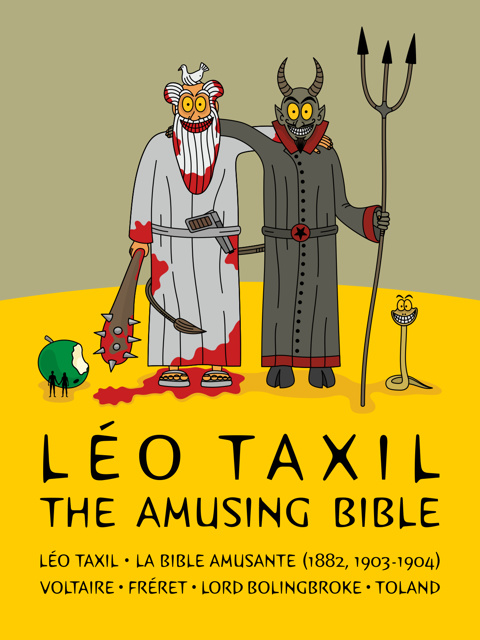
Léo Taxil - The Amusing Bible
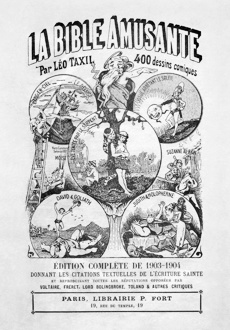
Giving the verbatim quotations of Holy Writ and reproducing all the refutations advanced by Voltaire, Fréret, Lord Bolingbroke, Toland & other critics.
Complete edition of 1903-1904
Paris, Librairie P. Fort, 19, rue du Temple, 19
Contents
|
About Léo Taxil
Dedication to the Infallible Holy Father
1. The creation and the earthly paradise
2. Short history of the first men
3. The angels living in concubinage on earth
4. General drowning of humanity
5. Happy life of a well-beloved patriarch
6. A family vowed to multiplication
7. Moses and the journey of forty years
8. The exploits of Joshua and of Gideon
9. The judges Jephthah and Samson
10. Sweet idyll of the fair Ruth
11. Story of Samuel before the monarchy
12. Saul, first king, and his rival David
13. Glorious reign of H. M. Solomon
14. The two kingdoms: Israel and Judah
15. During and after the captivity
Table of concordance
A Short Glossary of Taxil’s Words
About This Edition
|
About Léo Taxil
Léo Taxil is the pen name of Marie Joseph Gabriel Antoine Jogand-Pagès (Marseille, 21 March 1854 – Sceaux, 31 March 1907), a French journalist and writer remembered for his anticlerical satire and for one of the most audacious hoaxes of the nineteenth century. He took his pen name from Leonidas, a maternal ancestor, and from Taxiles, the Indian king allied with Alexander the Great. His father, a Catholic and royalist hardware merchant, meant him to grow up a pillar of the sacristy and had him taught by the Marist Brothers and the Jesuits. At fourteen, under the spell of Henri Rochefort’s clandestine paper La Lanterne, the boy broke with religion and tried to run away to join Rochefort in exile in Brussels. His father had him committed for two months to the Mettray Penal Colony, a reformatory for young offenders, where, by his own account, he swore eternal hatred of religion.
The hoaxer showed himself early. In 1873, with Marseille under martial law, letters from fishermen who had narrowly escaped sharks emptied the beaches, and the general in command sent a hundred armed men out on a tug to hunt the sharks. They found none. The fishermen did not exist, and the letters were all in one hand, but the author was never found. Only in 1897 did Taxil reveal that he had written them himself, at nineteen, to take revenge on the general for suppressing his paper, La Marotte. Some years later, in Geneva, where he had fled to escape sentences for press offences, he announced, by his own account, a Roman city sunk in the lake: tourists came from all over Europe, and a Polish archaeologist claimed to have made out a square and the remains of an equestrian statue.
In 1878 he settled in Paris, where he founded the publishing house Librairie anti-cléricale and the newspapers L’Anti-Clérical and La République anti-cléricale. In 1879 he was tried at the Seine Assizes for the pamphlet À bas la calotte!, on charges of insulting a religion recognised by the State and outraging public morals, and was acquitted. In 1881 he joined a Masonic lodge; it expelled him before the year was out, still in the first degree, that of apprentice.
In La Bible amusante (1882), some 400 pages illustrated by Frid’Rick, and in its New Testament companion, La Vie de Jésus, he retold the Bible with heavy irony, pointing out what he held to be its contradictions, errors and absurdities. Other books painted the leaders of the Church as libertines in the manner of the Marquis de Sade. The business did not last: in 1884 the Librairie went bankrupt, and police reports of that year describe him as destitute.
On 20 April 1884 Pope Leo XIII issued the encyclical Humanum Genus, which divided mankind into the kingdom of God and the kingdom of Satan, whose partisans were “led on or assisted” by Freemasonry. The pope made it the bishops’ first rule “to tear away the mask from Freemasonry, and to let it be seen as it really is”.
Taxil answered the call. In July 1885 he published in his own République anti-cléricale a letter disowning all his writings against religion, and the Anticlerical League he had helped to found expelled him as a traitor. After a retreat with the Jesuits and a general confession he was received back into the Church, and in 1887 Leo XIII granted him a private audience.
The convert turned his pen against Freemasonry, with the same vehemence and the same methods. His early anti-Masonic books mixed genuine rituals with inventions that made the Great Architect of the Universe the Devil in person. They sold: in 1889 he bought a château at Sévignacq, in Béarn.
From 1892 to 1895, in 240 instalments signed “Dr Bataille” and written with Charles Hacks, a ship’s doctor, Le Diable au XIXe siècle (The Devil in the Nineteenth Century) claimed to expose “Palladism”, a Luciferian Freemasonry of Taxil’s own devising, and its high priestess Diana Vaughan, who was just as imaginary. In its pages, at a séance in London, a table turned into a winged crocodile and played the piano; Diana’s rival Sophie Walder walked through walls, and her snake wrote prophecies on her back with the tip of its tail; Diana herself travelled from planet to planet and was betrothed to the demon Asmodeus. In 1895 Taxil launched a magazine in her name. After three issues it announced her conversion: she had let slip a word of admiration for Joan of Arc, at whose name the demons fled. Her Mémoires d’une ex-palladiste followed in instalments. Rome was gracious: Cardinal Parocchi sent her the pope’s very special blessing, and in 1896 the Jesuit review Civiltà Cattolica blessed “the noble Diana Vaughan”.
Doubts grew nonetheless. The bishop of Charleston, in South Carolina, where Taxil had set the seat of Palladism, went to Rome to assure the pope that the Freemasons of his city were respectable men and that their temple held no statue of Satan. Leo XIII sent his blessing to the first international anti-Masonic congress, held at Trent in September 1896 before thirty-six bishops, where Taxil was acclaimed. But at Trent the doubts came into the open: sceptics asked for Diana’s birth certificate and a certificate from the priest who had received her abjuration, and the congress appointed a commission to establish whether she existed. In January 1897 it found no proof either way, and Pierre Lautier, a prominent Catholic lawyer who had said he had lunched with her, admitted that he might have been deceived.
Taxil at last promised to produce her at a lecture on Easter Monday, 19 April 1897, at the Geographical Society in Paris. The evening opened with the raffle of a typewriter donated by “Miss Diana Vaughan”. Then, before journalists, priests, freethinkers, Freemasons and two delegates of the nunciature, Taxil spoke for two hours. He thanked the bishops and the Catholic press for their help with his crowning hoax, his own conversion, read out the approving letters from Rome, and announced that Diana Vaughan and Palladism were hoaxes too, part of a twelve-year practical joke meant to expose the credulity of the Roman Catholic Church. The name, he claimed, was that of a typist, the European agent of an American typewriter firm, who had lent it to him and hugely enjoyed corresponding with bishops and cardinals. The sharks and the sunken city, he said, had been the beginnings of a long career. In his general confession, he recalled, he had accused himself of an imaginary murder; now he confessed to infanticide: Palladism was dead, and its father had just killed it.
Some of the audience laughed, others hissed; a priest who climbed on a chair to reply was hooted down. Taxil had taken care to have canes and umbrellas left at the door; the tumult turned to blows all the same, and the police had to escort him to a nearby café. The newspaper Le Frondeur printed his lecture in full as Douze ans sous la bannière de l’Église (Twelve Years under the Banner of the Church). Rome made no answer; no sentence was needed, since a public apostate was excommunicated automatically. The fury came from the Catholic press, which had celebrated him for twelve years and now denounced him as a swindler.
None of this troubled Taxil. From 1897 La Bible amusante, which he had disowned in 1885, was back on sale, enlarged to some 814 pages with 400 numbered illustrations by Frid’Rick; the complete edition of 1903-1904 began with his open letter to Pope Leo XIII and, as its cover announced, set the verbatim quotations of Holy Scripture beside the refutations of Voltaire, Fréret, Lord Bolingbroke, Toland and other critics.
He divorced and remarried, and in 1899 left Paris for Sceaux, where a police report of 1902 found him living comfortably. He went on writing under other names: erotic novels as Prosper Manin and, from 1904, household manuals as Jeanne Savarin, among them a guide against food fraud. In his last years he worked as a printer’s proofreader. In 1906 an American magazine quoted his confession: he had made his tales of the Freemasons so grotesque that he thought everybody would see the joke, but the more he lied to show that he lied, the more he was believed. He died at Sceaux on 31 March 1907.
The Taxil hoax became a byword for the credulity it had exposed, yet the Palladist fictions are still sometimes quoted as fact in the literature on conspiracies and Freemasonry. La Bible amusante found its largest public in the Soviet Union, where it was translated as early as 1925; the Moscow edition of 1962 alone ran to 450,000 copies, and the book was reissued in 1965 and 1976, and in Minsk in 1988. Umberto Eco made Taxil and Diana Vaughan characters in his novel The Prague Cemetery (2010). The present edition, with its 400 illustrations, is one more sign that the book has outlived its author.
His anticlerical writings include:
À bas la calotte! (Down with the Clergy!) (1879)
Les Soutanes grotesques (The Grotesque Cassocks) (1879)
La Chasse aux corbeaux (The Crow Hunt, the crows being priests) (1879)
Le Fils du jésuite (The Son of the Jesuit) (1879)
Les Bêtises sacrées (Sacred Stupidities) (1880)
Les Friponneries religieuses (Religious Knaveries) (1880)
Plus de cafards! (No More Hypocrites!) (1880)
Calotte et calotins (Clergy and Clericals) (1880-1882)
Les Borgia (The Borgias) (1881)
Les Amours secrètes de Pie IX (The Secret Loves of Pius IX) (1881)
Les Pornographes sacrés (The Sacred Pornographers) (1882)
La Bible amusante (The Amusing Bible) (1882) — first edition, about 400 pages
Un Pape femelle (A Female Pope) (1882)
L’Empoisonneur Léon XIII (The Poisoner Leo XIII) (1883)
Pie IX devant l’Histoire (Pius IX before History) (1883)
La Vie de Jésus (The Life of Jesus) (1884)
La Prostitution contemporaine (Contemporary Prostitution) (1884)
Les Maîtresses du Pape (The Mistresses of the Pope) (1884)
La Vie de Veuillot immaculé (The Life of the Immaculate Veuillot) (1884)
La Bible amusante (The Amusing Bible) (1904) — complete edition, about 814 pages
The 400 drawings by Frid’Rick are taken from the first edition of 1882 (Paris, Librairie anti-cléricale), where they are printed larger (140 × 110 mm) and each has only a title and a few lines of text. The text is translated from the complete edition of 1903-1904 (Paris, Librairie P. Fort), which prints the same drawings smaller (102 × 80 mm). Taxil quoted mostly from Jean-Frédéric Ostervald’s Bible (1744), now and then changing its wording for comic effect; elsewhere he followed the translation Voltaire gives in La Bible enfin expliquée (1776). The chapter About This Edition, at the end of the book, explains how this edition presents Taxil’s text, the Bible quotations, the editorial notes and the page numbers of 1904, and gives the sources of this chapter.

The chapter About This Edition, at the end of the book, explains how this edition presents Taxil’s text, the Bible quotations, the editorial notes and the page numbers of 1904, and gives the sources of this chapter.
Dedication to the Infallible Holy Father

Most Holy Father,
They say that you have not been pleased since the 19th of April of this year, the twentieth of your glorious pontificate. The unexpected denouement of my merry mystification has put you, so we are assured, into a great rage, like a mere Père Duchesne (fr. ‘comme un simple père Duchesne’: ‘Le Père Duchesne’ was a newspaper of the French Revolution whose title character stormed and swore in the language of the street; ‘the great rage of Père Duchesne’ headed issue after issue); for to know that one has been mystified for twelve years by a sceptical freethinker is an eminently disagreeable thing, when one is the representative of the Holy Ghost, when one is directly and permanently inspired by the divine pigeon (fr. ‘le divin pigeon’, Taxil’s name for the Holy Ghost, whom Christian art shows as a dove); but to know that this ridiculous posture is known to the whole world, that is the height of unpleasantness, that is what vexes one in the supreme degree. O my pope, what a tile on the head (fr. ‘quelle tuile’, an idiom: what a sudden misfortune; the image is of a tile falling from a roof onto one’s head) for the dogma of your infallibility!...
A hoaxer (fr. ‘fumiste’, a stove-fitter, from ‘fumée’, smoke, and also a joker who keeps a straight face; in the 1840 vaudeville ‘La Famille du fumiste’ a stove-fitter grown rich plays pranks on people and each time says ‘c’est une farce de fumiste’, ‘it is a stove-fitter’s prank’, which gave the word its second meaning; Taxil gives the name to himself and to the writers of the Bible) of Marseille has treated himself to your venerable head (fr. ‘se payer la tête de quelqu’un’, a familiar idiom: to amuse oneself at someone’s expense); horror! — And he had taken his measures so that his hoax (fr. ‘fumisterie’, a deception kept up with a straight face; originally the stove-fitter’s trade) should end by bursting like a bomb, with a din resounding through the press of both hemispheres; malediction! (fr. ‘malédiction !’, an exclamation: on the French stage what ‘Curses!’ is on the English, the villain’s stock cry; Taxil is acting out the Pope’s rage, not his own)
Joachim, my old Joachim (Leo XIII’s own name was Gioacchino Pecci, Joachim in French as in English: Taxil calls the Pope by his Christian name, like an old crony; further on, Rochefort calls him by his surname, with the ‘le nommé’, ‘the man named’, of police reports), I understand your holy wrath.
I seem to see your grimace as you read that amusing article in which Henri Rochefort summed up the situation so well:
« This most holy father, who received the hoaxer in a private audience, cannot deny having been in collusion with him; otherwise his infallibility, which he has made into a dogma, would immediately be reduced to dust.
Since he did not perceive the trick his visitor was preparing to play upon him, what becomes of that light from on high upon which rests, in the eyes of the dotards of Catholicism, the whole power of the successors of St. Peter?
Léo Taxil has made fun of him, but he himself was making fun of us; and if the first has, for twelve years, made the bishops swallow his tall tales (fr. ‘blagues’; a ‘blague’ is a story invented and told with a straight face), the second has been making us gulp down his own for twelve centuries.
Either the man named Pecci is no more infallible than you or I, and nothing remains for him but to hand in, without delay, his resignation as representative of a god whom he in no way represents;
Or else, being infallible, he made himself the associate of a teller of tall tales whom he was using to extract money from the adversaries of Freemasonry; in which case there would be nothing left but to charge the gendarmes to go and arrest him in his palace, for breach of trust and fraudulent misappropriation. »
Three times alas! my old Joachim, that is the dilemma which an illustrious pamphleteer has put to you, amid the bravos of the gallery. And from Paris to New York, from London to Montevideo, the universal press has repeated the dilemma; and everywhere the applause has rung out, everywhere people have burst out laughing at your confusion, from everywhere mocking foot-long noses (fr. ‘les pieds de nez’, an idiom: the mocking gesture of thumb to nose with the fingers spread) have been sketched in the direction of your triple crown. And you wondered, O thirteenth of the blessed (fr. ‘sacrés’, sacred, and also, standing before a noun as here, a common swear-word meaning damned; English ‘blessed’ carries those same two senses, and in one word Taxil calls the thirteen Popes Leo both holy and damned) Leos, whether this were not indeed a nightmare!...
No nightmare at all. You were wide awake, and the tremendous burst of laughter which shook the globe was the irritating reality.
Most Holy Father, I owe you a consolation.
The flood of impiety swells every day; it is a veritable tide which rises, rises without ceasing. In dear France, who is the eldest daughter of the Church, education has been secularized for many years now; so that the new generations growing up in the schools of the State do not know the first word of Sacred History.
On several occasions I have observed, with unspeakable grief, that young people are ignorant of the edifying adventures of Abraham, Isaac, Jacob, Joseph, Moses, Joshua, Gideon, Samson, Samuel, Boaz, Saul, David, Solomon, Elijah, Elisha, Jonah, Ezekiel, Esther, Tobias, Judith, Daniel, etc., etc. Of these celebrated and venerated names they have at the very most a vague idea. To the question which a worthy priest lately put: « Do you know the Maccabees? » the answer came: « Very little; I have only been twice to see the Morgue. » (‘the Maccabees’ — fr. ‘les Macchabées’; in slang a ‘macchabée’ is also a corpse: the young man took the priest to be asking about the dead laid out at the Paris Morgue, then open to the public)
Such a state of things is distressing. Where shall we end up, just heaven, if the knowledge of the pious episodes of the Bible is lost, if the writings formerly inspired by the divine pigeon fall into oblivion?... It is time to react, Most Holy Father.
That is why I am undertaking a new edition of the Holy Scriptures. I shall omit nothing, and I shall try to make this reading as attractive as possible. You shall see. On my next journey to Rome, I shall solicit from your august hand yet another special benediction, to be added to my precious collection.
If, however, taking my word for it, you deign to send me this benediction of the first quality without waiting for my visit — Most Holy Father, do not constrain yourself (fr. ‘ne vous gênez pas’, an idiom: go right ahead, don’t hold back; usually said ironically to someone taking liberties, here a cheeky invitation to the Pope).
The joy of having mystified you in no way diminishes my zeal for the diffusion of the great eternal truths which are the basis of the sublime religion whose sovereign pontiff you are. I do not say that my Amusing Bible will contribute much to strengthening the faith; but it will nevertheless have one incontestable advantage: by penetrating among the victims of the secularizing State, by getting itself read by those who now are ignorant of, or know only vaguely, all these fine things, it will reveal to them what one must believe in order to have the right to call oneself a son of the Catholic, Apostolic and Roman Church.
If, after that, a few are willing to admit that it is possible for a man to live three days in the belly of a whale, not to speak of the other biblical miracles, you will owe me, my old Joachim, warm thanks for having gained you some unhoped-for recruits.
So then, no rancour over my mystification, is there?... This book will have consoled you, and we shall become good friends again, as before the 19th of April.
Come, do not wait to be begged, Leo (fr. ‘ne te fais pas prier, Léon’: in this last line Taxil drops the ‘vous’ he has used to the Pope throughout the dedication and says ‘tu’, as to an old friend). Send me a little instalment of benediction, by return of post.
Paris, 20 June 1897 - Léo Taxil.
[1] CHAPTER 1
The creation and the earthly paradise
Now then, learn what the spirit of God dictated to Moses, the supposed sacred author to whom Genesis, the first book of Holy Scripture, is attributed; and you will find at every turn that the spirit of God, unless he be crassly ignorant, is a hoaxer, essentially a hoaxer, more of a hoaxer than the inventor of the palladist grand-mistress Diana Vaughan (that is, Taxil himself: Palladism, a Luciferian Freemasonry, and its grand-mistress were his hoax, unveiled on 19 April 1897; the spirit of God is thus a bigger hoaxer than he).
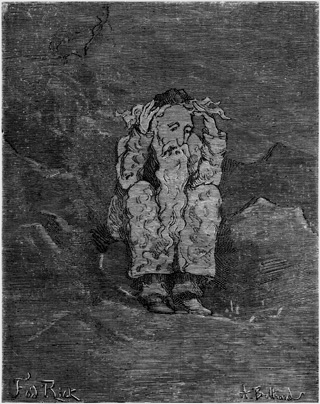
God is from all eternity; but, at the beginning of time, he was alone in the void. Nothing existed save him, who then called himself Elohim, the Hebrew name by which he is designated in the first verse of the Bible; and this name is a plural, which is very singular for a gentleman all by himself.
So then, Elohim — who is also Jehovah, Sabaoth, Adonai, as we shall see further on — Elohim was bored (or were bored) at six francs a head (fr. ‘s’embêter à six francs par tête’, an idiom: to be extremely bored; the image is of boredom paid for at a high price) in the midst of his chaos; « tohu-bohu » (a word French and English took alike from the Hebrew ‘tohu wa-bohu’ of Genesis 1:2, ‘without form and void’: a formless jumble) is the biblical term, tohu-bohu, which means upside down.
1. The chaos.
As eternity is immoderately long, master Elohim was bored for billions and billions of centuries. At last he had an idea: being God, that is to say all-powerful, he judged that to go on being bored for ever without doing anything would be the height of stupidity (fr. ‘le comble de la bêtise’: a play on words, as ‘s’embêter’, to be bored, is made from ‘bête’, beast, fool, like ‘bêtise’, stupidity), and he resolved to create.
He might have created everything at a single stroke. Well, no; it seemed to him better to take his time. And he made the heaven and the earth, or, more exactly, matter appeared by the mere effort of his will; matter that was formless, empty, [2] confused, still tohu-bohu, and full of damp. « And the wind of God was running upon the waters » (verbatim); the reader is not obliged to understand.
In order not to commit blunders, it was necessary, above all, to see clearly; whence one is entitled to conclude that, during the preceding thousand billion centuries, this poor Papa Good God (fr. ‘papa Bon Dieu’, Taxil’s name for Jehovah: a good-natured father one speaks to familiarly, not the God of the theologians) was in the most complete darkness.
[3] Fortunately, he never knocked his nose against anything anywhere, since there was nothing at all.
« — Let there be light! » commanded the Eternal.
« And there was light. »
What was this light? The Bible does not say; it confines itself to informing us of this: « God saw that the light was good ». He was satisfied with it, consequently. His first care was then to « separate the light from the darkness »; again it [4] is useless to seek to understand. « And God named the light, Day; and the darkness, Night ». — « Thus was the evening, thus was the morning. » Such was the first day of the creation.
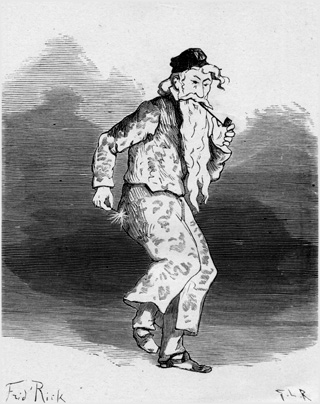
2. Creation of the light.
After which, Papa Good God busied himself with creating... guess what... the expanse, or, if you prefer, space. If one will but reflect upon it a little, it is clear that space had always existed, even supposing a time when it was furnished with no star, no planet. Nevertheless, the expanse was created after the light, although « created » is not the proper term here. The Bible, very muddled in its first chapter, has taught us, as we have just seen, that at the beginning of the creation Elohim made the heaven and the earth in tohu-bohu, with formless matter and confused masses of waters over which the wind of God was running; and here is how the sacred book explains this second operation, the formation of the expanse: « God created the expanse and separated the waters which are above the expanse from those which are below the expanse; and it was so. » (Genesis 1:7) Some commentators say that the atmosphere is meant. In any case, in verse 8 we read: « And God named the expanse, Heavens. Thus was the evening, thus was the morning; that was the second day. »
(‘the expanse’ — fr. ‘l’étendue’, the word of Ostervald’s Bible, where the King James Bible has ‘firmament’. The Hebrew ‘rāqîaʿ’ is a plate beaten out thin, as metal under the hammer: a sky both spread and solid. The King James Bible kept the solidity, Ostervald’s Bible only the spreading, and Taxil’s joke turns on that expanse.)
Be that as it may, it emerges from this that the Holy Ghost told the author a superb tall tale and abused his simplicity. This story of waters above and waters below is the reproduction of a gross error of primitive peoples. Indeed, all the ancients believed that the heavens were something solid, firm — whence the name of « firmament » — and they even imagined them to be of crystal, seeing that the light passed through; and the opinion was that above this solid plate, this firmament, there was an immense reservoir of water. Today we know that rain is water drawn up, pumped up by the sun, turned into vapours, into clouds, and falling back afterwards upon the earth; but formerly it was believed that rain came from the great reservoir above; people imagined something like windows opening and closing again in the plate of the firmament and thus producing the rains. And this opinion, which now makes us laugh, was current for a very long time; it is the view of Origen, of St. Augustine, of St. [5] Cyril, of St. Ambrose and of a considerable number of doctors of the first centuries of Catholicism. The hoaxer Holy Ghost was making fun of them.
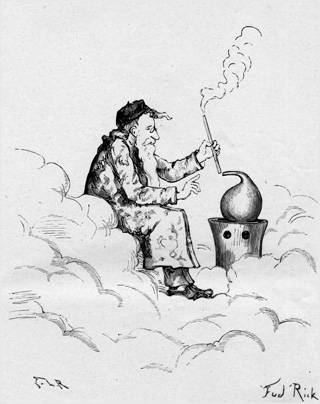
3. Creation of the atmosphere.
Well, let us pass on. Papa Good God spent the third day on a task whose results are more appreciable than those of the preceding days. He lowered his gaze upon the waters below, and he said to himself that it would be useful to gather them together, so as to make dry parts appear, that is to say continents.
Then the waters, very obedient to his will, assembled apart in depths hollowed out for their gathering; on the other hand, heights were formed, bristling the surface of the solid matter with mountains, while the liquid rolled in slow or headlong waves towards the new abysses. « And God named the dry, Earth; he named also the gathering of the waters, Seas. And God saw that it was good. »
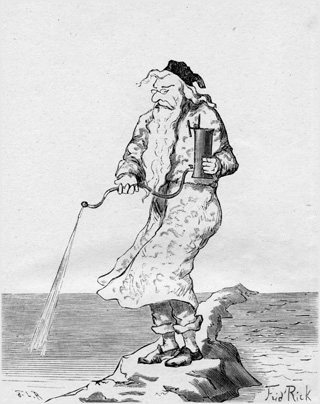
4. Creation of the continents and the seas.
Note that Papa Good God was, most often, pleased with his job. — Name of a pipe! (fr. ‘Nom d’une pipe !’, an oath: good heavens!; it is ‘Nom de Dieu !’, ‘name of God!’, with a pipe put where God stood, so that no blasphemy is spoken) he must have said to himself, what a mussel (fr. ‘moule’, a fool, soft and spineless like the shellfish) I was not to have created that sooner!
That day he was so satisfied with his continents and his seas that he wished to do something more before nightfall. « Let the earth put forth its shoot, said he, namely, grass bearing seed, and fruit trees bearing fruit each according to its kind, which have their seed in themselves upon the earth. And it was so. » (Genesis 1:11)
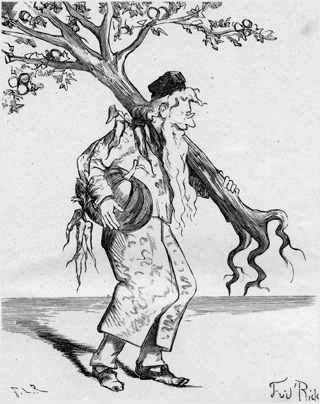
5. Creation of the trees and the plants.
One cannot sufficiently admire this delicate attention of the Creator. Impossible to be more full of precautions than he. Indeed, one wonders what the earth would be like if God had planted it with fruit trees each bearing fruits other than those of its own kind. Let us thank the paternal Elohim for not having given us apricot trees producing oranges, orange trees producing apples, apple trees producing currants, etc.; there would be no telling one from another. Ah! yes, let us thank God; what a good, provident papa!...
When the earth had obeyed him and the apricot trees had grown up bearing apricots, God, once again, « saw that it was good. Thus was the evening, thus was the morning; that was the third day ».
But here is quite another story! Three days had [6] already passed with evening and morning, thanks to the light created at the very beginning: only, strange to say, this light which disappeared at the end of the day to make way for the darkness of night, this light illuminated the newborn world without having any source; no more sun than at the bottom of a coal mine. This drollery deserves a verbatim quotation from the Bible:
« 14. Then God said: Let there be luminaries in the [7] expanse of the heavens, to separate the night from the day, and let them serve for signs, and for the seasons, and for the days, and for the years;
15. And let them be for luminaries in the expanse of the heavens, to give light upon the earth; and it was so.
16. God therefore made two great luminaries: the greater luminary, to rule over the day, and the lesser, to rule over the night; he made the stars also.
17. [8] And God set them in the expanse of the heavens, to give light upon the earth:
18. And to rule over the day and over the night, and to separate the light from the darkness; and God saw that it was good.
19. Thus was the evening, thus was the morning; that was the fourth day. »
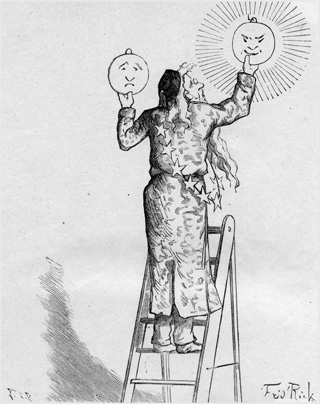
6. Creation of the heavenly bodies.
No mix-up, is there? it is indeed the sun and the moon that are meant. Consequently, according to the Holy Ghost, the creation of the sun followed the creation of the light by four days! Now, the Holy Ghost knows everything, of course; otherwise he would not be the Holy Ghost, but a mere imbecile. Every time science makes a discovery, the Holy Ghost must laugh into his pigeon’s beak (fr. ‘rire dans son bec de pigeon’, after the idiom ‘rire dans sa barbe’, to laugh into one’s beard: to laugh secretly, as English says ‘to laugh up one’s sleeve’; Taxil puts the pigeon’s beak in place of the beard) and murmur to himself: I have known that from all eternity; these poor pygmies of men go to great trouble to learn what is!
But then, why did the Holy Ghost also dictate this colossal stupidity to Moses, about the light and the sun?... What a hoaxer, decidedly!...
Indeed, down to Ole Rømer, an astronomer of Copenhagen, who lived in the seventeenth century (1644-1710), it was believed that the sun did not produce light, but that light existed in space and that the sun served only to « push » it; this false physical conception was an error of Descartes himself. It is to Rømer that science owes the demonstration of this important truth, directly contrary to the statement of the Bible, that is to say: the light which illuminates our world emanates from the sun and its propagation is not instantaneous. The great Danish astronomer even succeeded in determining the speed of solar light exactly; he established, and today this has been proved a thousand times over, that this light takes eight minutes eighteen seconds to reach us from the star which is its source, that is a speed of 308,000 kilometres per second. We know that Rømer was led to this great discovery by the observation of the eclipses of the satellites of Jupiter, a planet forming part of our solar system. Rømer was then in France, and he hastened to announce his discovery to the Academy (See the History of the Academy, sitting of 22 November 1675.)
[9] One may say further, with Voltaire: « If God had first spread the light through the air to be afterwards pushed by the sun, and to illuminate the world, it could not be pushed, nor illuminate, nor be separated from the darkness, nor make a day from evening to morning, before the sun existed; this theory is contrary to all physics, and to all reason. »
Moses, very ignorant of astronomy, therefore let himself be duped by the Holy Ghost; for the divine pigeon knew, at the time when Genesis was written, what Rømer was to discover in 1675.
Note also how little importance the stars have, in the creation according to the Bible. The « two great luminaries » are the sun and the moon; the moon! which is only a satellite of our terrestrial planet! Ignorant Genesis is very far from suspecting that the moon, the earth, and even the sun are very small things in the universe; that our brilliant sun, the central star of the world we inhabit, is a modest star, one of the innumerable stars which compose the Milky Way. The sacred author sees only the earth and refers everything to the earth, that tiny planet which, in reality, turns about a star of the seventh magnitude; and this star-sun the wretched writer makes dependent, astronomically, upon its planet!
Ah! the unfortunate Moses would be open-mouthed, were he resurrected in our day. I imagine what a head he would make (fr. ‘quelle tête il ferait’, an idiom: how astonished he would look) if, coming to study at any observatory in Europe or America, he learned, for example, what Sirius is, a star of the first magnitude: Sirius, the most beautiful and the most brilliant of the stars of the sky, to which the Holy Ghost neglected to call his attention; Sirius, whose light takes nearly twenty-two years to reach us, for its distance from the earth is 52,174,000 million leagues, that is 1,373,000 times the distance from the sun to the earth. What would poor Moses say, on the day when someone revealed to him the prodigious importance, in the universe, of the other solar worlds which he did not even suspect?
Suppose the professor, following Humboldt, simply taught Moses this: — Although placed at so great a distance, Sirius and our sun belong to the same layer of stars, isolated in the celestial spaces, an island of stars in the universe; and this island of worlds and of suns, of flattened, [10] lenticular form, measures along its major axis eight hundred times the distance from Sirius to the earth; and yet it is only a small layer, extremely thin, if one compares it with the great layers, thick and deep, and incomparably richer in stars and in suns, which surround it. — Moses, who of his own accord believed that the earth is the centre of the universe created by God, would be driven mad by it.
Let us return to the creation according to the Bible:
« 20. [11] Then God said: Let the waters bring forth in all abundance animals which move and which have life; and let the birds fly above the earth, towards the expanse of the heavens.
21. God therefore created the great fishes, and all the living animals which move, which the waters brought forth in all abundance, according to their kind, and every bird having wings, according to its kind; and God saw that it was good.
22. [12] And God blessed them, saying: Increase and multiply, and fill the waters in the seas; and let the birds multiply upon the earth.
23. Thus was the evening, thus was the morning; that was the fifth day.
24. Then, God said: Let the earth bring forth living animals according to their kind; the domestic animals, the reptiles and the beasts of the earth, according to their kind; and it was so.
25. God therefore made the beasts of the earth according to their kind, the domestic animals according to their kind, and the reptiles of the earth according to their kind; and God saw that it was good. »
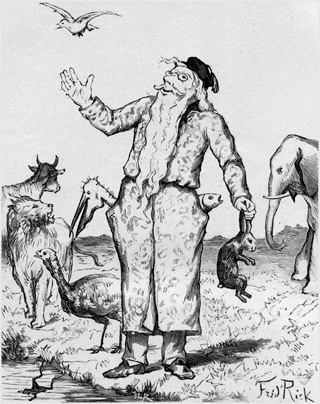
7. Creation of the animals.
Indeed, all that was good, and master Elohim, who has hands, rubbed them with satisfaction. But there was better still to create.
— Not one of these animals resembles me, and it is a pity! he thought. And yet I have a fine head, a keen ear, a lively eye, a witty nose, and a good set of teeth! I could very well create a mirror in which to contemplate myself; but it is better, I think, to contemplate myself by looking at my fellow... Come, it is settled; there absolutely must be upon earth an animal that has my head.
While Papa Good God was reasoning thus with himself, it is to be presumed that divers monkeys, of recent creation, came capering about him.
— They have something of me, he must have said to himself; but all the same, that is not it. Nearly all of these species are adorned with a tail, and I have no tail. As for those which are deprived of that caudal appendage... no, that is not it either!...
And the monkeys grimaced and went on cutting their wondrous capers.
Then Papa Good God took a block of damp earth, and « kneaded » it. — After that, come and maintain that God is a pure spirit and has no hands! — The Bible also says that God, having formed man, « breathed into his nostrils a breath of life ». So there we have the first man kneaded, then animated with a great deal of spittle. That is how « man was made into a living soul ». (Genesis 2:7)
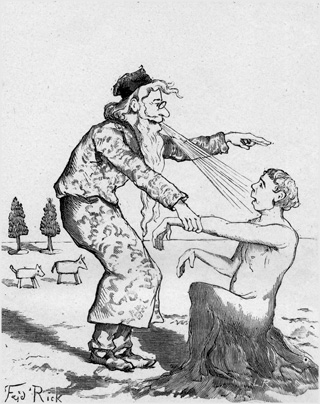
8. Creation of man.
There is a passage, none too clear, in the first chapter [13] of Genesis, verse 27, which has led some occultist commentators to believe that, in the first instance, man had been created hermaphrodite, but that God afterwards changed his mind. For it is only at the end of the second chapter that there is any mention of the creation of woman; now, 25 verses earlier, the Bible says, written out in full: « God therefore created man in his image; he created him male and female in the image of God (fr. ‘il le créa mâle et femelle’: Ostervald’s Bible has ‘il le créa à l’image de Dieu ; il les créa mâle et femelle’, as the Hebrew does, passing from ‘him’ to ‘them’: the translators altered nothing; the singular is Voltaire’s, ‘il le fit mâle et femelle’). » It is this verse, translated literally from the Hebrew text, which gave birth to the legend of the Androgyne God, widely credited in the various occultist schools; and, on the other hand, since this verse is highly awkward, Christian translators have always taken care to alter it. Nevertheless, one would be wrong to attach too much importance to this biblical fancy; many other passages are still less comprehensible!
Let us look rather at what is generally admitted.
From the moment of man’s formation, Papa Good God constituted him king of the creation. He immediately made him review all the animals. « For the Eternal God had formed all the beasts of the earth and all the birds of the heavens; then he had made them come unto Adam, that he might see how he would name them, and that the name which Adam should give to every living animal might be its name. »
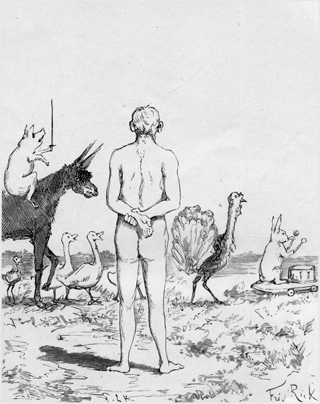
9. Man reviews the animals.
One can picture that procession; it is Buffon, no doubt, who would gladly have been in Adam’s place!
« Thou shalt fill the earth and subdue it, it had been said to Adam; thou shalt have dominion over the fishes of the sea, and over the birds of the heavens, and over every beast that moveth upon the earth. » As king of the creation, man does not always have the upper hand, when he has to deal with a lion, a tiger, a bear, a crocodile; that is what one may answer. And not only do the ferocious beasts crunch us, but humanity is also the victim of a thousand disagreeable insects, fleas, bugs, scorpions, not to speak of the Jesuits and other cockroaches (fr. ‘cafards’, both cockroaches and hypocrites who make a show of piety; Taxil means the hypocrites).
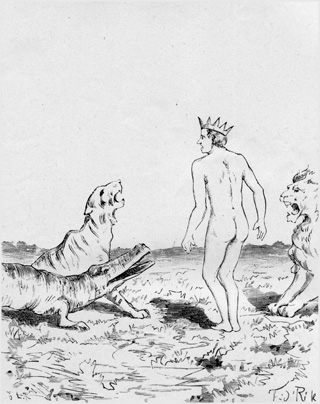
10. Man, king of the creation.
Moreover, God, who had created the ferocious beasts that relish human beefsteak, ordered man to be a vegetarian. « Behold: I have given thee every herb bearing seed which is upon all the earth, and every tree which hath in itself tree-fruit bearing seed; which shall be to thee for food. »
Finally, with everything finished — or nearly so — on [14] the evening of the sixth day, Papa Good God, happy and more and more satisfied with his work, and perhaps slightly tired, invented the siesta and set man the example of rest by resting himself, on the seventh day, like a good fat rentier (a word English shares with French: a man who lives on his ‘rentes’, the income from invested money, and does no work; the stock comic bourgeois of the day) who feels the need to do nothing more. (Genesis 2:2)
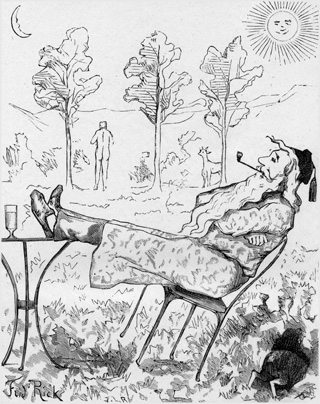
11. The Lord rests.
« And the Eternal God had planted a garden in Eden, on the side of the Orient, and he had put there the man whom he had formed... And a river went forth out of Eden, to water the garden, and it [15] divided itself into four rivers. The name of the first is Pison; it is that which floweth round about all the land of Havilah, where gold is found; and the gold of that land is good; it is there also that the bdellium and the onyx stone are found. The name of the second river is Gihon; it is that which floweth round about all the land of Cush. The name of the third river is Tigris; it is that which floweth in the country of the Assyrians. And the fourth river is the Euphrates. » (Genesis 2:8, 10-14)
[16] By going into these details, the author of Genesis wished to give an approximate idea of the site of the marvellous Eden. But he would have done much better to say nothing; for it is impossible to be caught more foolishly in the very act of gasconade (fr. ‘gasconnade’: extravagant boasting, from the reputation of the Gascons for bragging).
Indeed, all the commentators agree that the Pison is the Phasis, later named the Araxes, a river of Mingrelia, which has its source in one of the most inaccessible branches of the Caucasus, and, if there are gold and onyx in that region, on the other hand nobody has ever been able to discover what was to be understood by bdellium. Moreover, there can be no mistake about the third and fourth rivers, the Tigris and the Euphrates; whence it clearly follows that, according to Genesis, the site of the earthly paradise would have been situated in Asia, in the region of the massif of Ararat, in Armenia, although (first blunder of the sacred author) the Araxes, the Tigris and the Euphrates have sources which, while relatively near one another, are perfectly distinct. The Araxes, far from being derived from another river, issues from the volcano Bingol-Dagh, whence it flows towards the Caspian Sea. As for the Tigris and the Euphrates, not only do they not proceed from one and the same river, but on the contrary they join each other at Korna, to form the Shat-el-Arab and to empty into the Persian Gulf.
As to the second river, which Genesis calls Gihon, the blunder of the sacred author is fantastic. « It is, says he, the river of the land of Cush. » Now, according to the version of the Septuagint and even the Vulgate, the land of Cush (son of Ham and father of Nimrod) is none other than Ethiopia; consequently, this Gihon is the Nile, which flows, not in Asia, but in Africa, and precisely in the opposite direction to the Araxes, the Tigris and the Euphrates, since the general direction of the great African river’s course is from south to north. If one places the source of the Nile at the Victoria Nyanza, as is admitted so as not to go further upstream, there are then at the very least eighteen hundred (the 1904 text has ‘dix-huits cents’) leagues between the sources of the first and second rivers mentioned by Genesis as watering the same garden of Eden! It is true that the other two have their sources only sixty leagues from one another; which is [17] already a nice stretch for a garden. Besides, is this immense territory, bristling with the most precipitous peaks, formed of one of the most impracticable regions of the globe, a garden?...
Finally, the third blunder, and this one might be called: the blunder of the tip of the ear (fr. ‘la bévue du bout de l’oreille’, a coinage: the blunder that gives the writer away; Taxil builds it on ‘montrer le bout de l’oreille’, ‘to show the tip of one’s ear’, to betray oneself, like La Fontaine’s ass in a lion’s skin, caught out by the tip of its ear).
The priests, as we know, maintain that the work of Moses is the Pentateuch, that is to say the first five books of the Bible: Genesis, Exodus, Leviticus, Numbers and Deuteronomy. But the learned have had the impiety to make researches, and their general opinion is that these books were manufactured by Ezra, on the return from the captivity of Babylon, in the course of the fifth century before Jesus Christ, whereas Moses, supposing that he existed and granting for a moment that the dates which concern him are authentic, lived a thousand years earlier: born in the land of Goshen, in Egypt, in 1571 before our era, and died in Arabia, on Mount Nebo, in 1451.
Bossuet was indignant at the writings of Hobbes, Spinoza and Richard Simon against the authenticity of the works of Moses; to say that the true author of the Pentateuch is Ezra is to blaspheme, according to the fiery bishop: « What can one object, he cries (Discourse on Universal History), to a tradition of three thousand years, sustained by its own strength and by the sequence of things? Nothing coherent, nothing positive, nothing important! »
May it not displease Bossuet (fr. ‘N’en déplaise à Bossuet’, an idiom: with all due respect to Bossuet; the polite formula said just before contradicting someone), verse 14 of chapter 2 of Genesis, among other examples, gives a striking proof of the literary and religious imposture, and demonstrates, as plainly as two and two make four, that the said Genesis cannot have been written by Moses. This is the verse that says: « The name of the third river is Tigris; it is that which floweth in the country of the Assyrians (fr. ‘au pays des Assyriens’, the four words Taxil counts; Ostervald’s Bible reads ‘vers l’Orient de l’Assyrie’, toward the east of Assyria, as does the King James Bible). » (Genesis 2:14) There it is, written out in full. Some translators have replaced the last four words by: « toward the East of Assyria »; but that changes nothing. The question is this: Moses, who died in 1451 before Jesus Christ, could not use the expressions Assyria, Assyrians, for the good reason that the Assyrian empire, which extended over both Nineveh and Babylon and which lasted down to the eighth century before our era, began to exist about 1300, at the [18] very most. The testimonies of Herodotus and of the Chaldean Berosus agree upon this point and have been confirmed by the monuments.
The important discoveries made since the beginning of our century in the history of the peoples of the ancient East, with the help of inscriptions in hieroglyphic and cuneiform characters, no longer allow anyone today, even in the most elementary books, to reissue the biblical [19] asininities about this first part of the annals of the human race. The results obtained by the Champollions, the de Rougés, the de Saulcys, the Mariettes, the Opperts, the Rawlinsons, the Lepsiuses, the Brugsches, etc., light up ancient history with a light far more certain than the traditions collected by the hoaxer Ezra.
It is established that the founder of the Assyrian empire was a prince named Ninippaloukin on the monuments, who [20] lived a hundred and fifty years after Moses. Moreover, the region which was called Assyria was known, in the time of Moses, by the name of the empire of the Rotennou, as appears from the Egyptian monuments, mentioned by Oppert and other scholars; for we see, in divers Egyptian inscriptions, that the kings of the eighteenth dynasty of Egypt, contemporaries of Moses, carried their arms into Babylonia and exacted tribute from the Rotennou, who were dominant in Mesopotamia, in the very country of the Tigris and the Euphrates. If Moses were the true author of Genesis, he would then have written: « the Tigris, a river which flows in the country of the Rotennou. »
It is true that the tonsured ones will always be able to answer us: — The true author of Genesis is neither Ezra nor Moses; it is the Holy Ghost! Consequently, were the Bible even to mention St. Petersburg and New York, that ought not to appear illogical to us and could in no way surprise us.
Let us therefore bow, and take up the rest of the blessed narrative, with a merry laugh; for this edifying Genesis really does not lack gaiety.
If the reader is willing, we are going to transport ourselves in thought to that marvellous garden of Eden, where four great rivers proceeding from a single fountain roll their waters. We seem to see Adam, walking about his property and giving himself up to the sweets of far-niente.
Here is what his monologue might be:
« — I am the man, and my name is Adam; which means, it appears, « red earth », seeing that I was manufactured out of clay, like a common piece of pottery... What is my age?... I was born five days ago; but, according to an old proverb, one is the age one appears. And that is why I can say that in reality I was born at the age of twenty-eight, with all my teeth... No; not with all my teeth... I still lack my wisdom teeth...
Very well built, eh?... Naturally! (fr. ‘Dame !’, an exclamation: what is left of an old oath, ‘Notre-Dame !’, Our Lady, or, as Littré has it, ‘dame Dieu’, Lord God; by Taxil’s time it was no longer felt as an oath) how could I fail to be a fine individual, since, save for the age and the beard, I am the faithful copy of the lord Jehovah, the most astoundingly (fr. ‘épatamment’, a familiar word, from ‘épater’, literally to knock flat) chic being that exists in the universe?... Just look [21] at this health, these robust arms, these legs of steel, nerves to spare, and, with that, a fresh complexion... Not the least rheumatism... I say blast (fr. ‘zut’, an exclamation of annoyance or refusal; to say it to illnesses is to snap one’s fingers at them) to illnesses... I need not even fear the smallpox; Papa Good God manufactured me all vaccinated... And so, how I swallow myself (fr. ‘ce que je me gobe !’, a slang idiom: how pleased with myself I am; ‘gober’, to swallow whole, was also slang for thinking highly of someone)!... and I am not wrong...
I let life flow sweetly (fr. ‘je me la coule douce’, a familiar idiom: I live an easy life, without a care), in this charming abode... no concierge... not even a servant... That is a happy life!... I go, I come, I gather fruits, all succulent, and I stuff myself with them to my confounded fancy, braving diarrhoea without danger... I feel no fatigue, however long my walks may be; when I lie down on the grass, it is for my pleasure...
The other day, the amiable lord Jehovah offered me a diversion whose merry memory I shall keep all my life... All the animals of the creation passed before me: « The name that thou shalt give to each living animal shall be its name », the old Eternal Father said to me... As an attention, that was kind, that was!...
It is unheard-of, how many animals filed past!... I should never have believed that there were so many living beings... I was at no loss to make my distribution of names among them; for the language which I speak without difficulty, and without ever having been to school, is a language of extraordinary richness, with an abundance of terms of which it is impossible to form an idea... Thus, without needing to search, I knew instantly all that is proper to each animal, merely by looking at it, and by a single word I expressed all the properties of each species, so that each name given by me is at the same time a complete and perfect definition... Let us take, for example, the animal which will later be called equus in Latin, cheval in French, horse in English, etc. Well, I clapped a name on it which expresses that quadruped with its mane, its tail, its neck, its speed, its strength... And the bird which, in centuries to come, will be called bulbo in Latin (the Latin word is ‘bubo’), hibou in French, owl in English, etc., all these names to come will not be worth the one I devised and which characterizes the nocturnal bird of prey, with its two mobile tufts upon the forehead, its short and hooked beak, its big head with great round eyes surrounded by a complete [22] circle of stiff feathers, its feet all furnished with feathers down to the claws, as well as its fierce and savage habits, its monotonous and lugubrious cry, its horror of the light... And so on, for all the living animals... Ah! the language I speak is without equal, and how sad it is to think that one day it will be entirely and for ever lost!... This thought is my only sorrow... Let us drive it away very quickly, and have no care.
[23] Oh! that general review of all the living animals, that is what was superb... Still, superb does not say everything; for we had a comic turn in the programme of the fête: it was the arrival of the fishes... Only think! this garden is right in the middle of a continent, no sea shores, nothing but rivers, that is to say fresh water... So then, you can picture the grimace the sea fishes made, in coming up the Tigris and the Euphrates to reach me; they were no longer in [24] their usual salt water, and it annoyed them!... Truly, it was enough to make one double up... And the great cetaceans, they were the ones that were cramped!... Fortunately, for that day and by way of exception, Papa Good God widened the rivers of my garden; otherwise the various species of whales could never have got through... As soon as I had given them their name, you should have seen them dart back and rush off, with great strokes of their fins, to regain their Ocean as fast as ever they could... I laugh at it still!...
Perhaps there will be people who will not believe this story... The impious will deny that seals from the North Pole could have come as far as Armenia, into the upper waters of the Tigris and the Euphrates, and in a single day’s journey at that, coming down the whole Atlantic and making the complete circuit of Africa; they will say that these interesting marine mammals, dwellers in the Frozen Ocean, could not change their element without dying of it... Eh! what does criticism matter!... Upon my word of honour, I saw seals and whales here, in this garden of Eden, on that occasion, and I add that the seals, quite pleased at having received a name from me, thanked me by saying: papa! mamma!...
Punctilious minds will object: « And the fishes of the lakes, which way did they come?... » Are they alluding to the lavaret (the lavaret, a whitefish of the Alpine lakes of Savoy; the ‘féra’ named with it is the whitefish of the Lake of Geneva), that delicious fish of Lake Bourget, which the inhabitants of Aix-les-Bains speak of as a glory?... And the féra, which lives exclusively in Lake Leman, which dies as soon as it is put into any other water, even fresh, which cannot so much as live in the Rhone, on this side of the Leman or beyond it?... Let it then be known: the lavaret and the féra had special permission from God; these two lake fishes came, by aerial route, to pay me a visit at Eden... And voilà! anathema on the miscreants who will not be content with this explanation!...
And then, by blue’s blood! (fr. ‘palsambleu !’, an oath: confound it!; it is ‘par le sang de Dieu’, ‘by God’s blood’, with ‘bleu’, blue, put where ‘Dieu’, God, stood, so that the oath could be sworn without naming God) it is very good of me to discuss these things... So much the worse for whoever will not believe me, when I affirm that I saw all the living animals, vertebrates, ringed animals, molluscs, and zoophytes!... There is not a single insect to which I did not give a name... But the one that most stupefied me is a great white worm, long, flat, which came [25] out quite gently from my own self, an ugly worm which future naturalists will call the tænia or solitary worm of man, and which resembles neither the tænia of pigs nor the tænia of sheep; this great devil of a human worm, on coming out, made me a profound bow; I gave it a name; after which it slipped back into me by my anus and took up its domicile again in my person... If I speak of it, it is in order to omit nothing; for I did not know myself to be inhabited. Apart from that, my lodger incommodes me in no way... Nothing troubles this life of Cockaigne (fr. ‘vie de cocagne’, an idiom: a life of idleness and plenty, as in the ‘pays de cocagne’, the land of Cockaigne, the imaginary country where everything comes without work) which I have been leading for five days... »
Adam looks at himself in the limpid water of the fountain, the source of the four great rivers; then, spying a lawn, he sprawls lazily upon it.
— Ah! how good it is to live thus! he murmurs.
But now he yawns... he stretches himself... an unknown languor gradually takes hold of him... Here is something new, really!... And yet he feels no fatigue... What can this mean?...
He understands nothing of it. He yields to the mysterious, irresistible influence. His eyelids close. Adam sleeps. It is the first sleep of man.
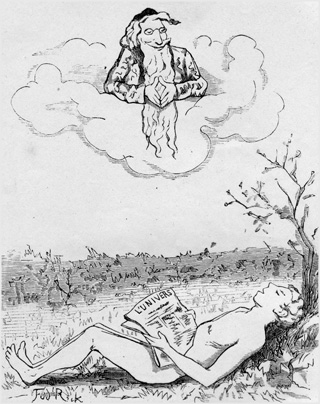
12. First sleep of man.
While Adam is snoring like a German humming-top (fr. ‘ronfle comme une toupie d’Allemagne’, an idiom: snoring very loudly; the German top is a hollow spinning top that hums as it turns), Papa Good God comes down upon earth.
First, he rests his gaze for a fairly long while upon the sleeper.
— All the same, I do good work when I set about it! says he with satisfaction. The fellow is uncommonly well built; one would swear it was myself... when I was a few billion centuries younger.
Stooping, he pinches the fat of his calf. To this divine pleasantry Adam replies with a snore still more sonorous than the preceding ones.
— Perfect! continues master Elohim; I shall have no need of an anaesthetic to ensure the success of my talents as a surgeon... I see that the sleep I sent to my dear young Adam was of the very best make; one might fire a cannon beside him without his waking... Now, I must set to work; for I have come here for an operation of the first order... While nobody hears me, I may as [26] well make a confession: I realised this morning that there are moments when I am somewhat of a simpleton. So, where was my head when I created man without a companion?... I gave every animal a female; at least, there are but few exceptions to this rule. I created the solitary worm (fr. ‘ver solitaire’, the everyday French name of the tapeworm) hermaphrodite, and that is understandable, since, if it went in couples in the intestines where it dwells, it would no longer be a solitary worm... But man is not a tænia, name of a pipe!...
[27] I must therefore manufacture him a companion, and I have decided to make her for him out of his own flesh...
Papa Good God went round Adam for a moment; he felt him over, while uttering his reflections aloud.
— I consulted the Pigeon on this subject, he continued, and I was right to, for he is craftier than I... My first idea had been to cut off a corn from dear Adam and to knead a little woman out of it... The Pigeon did not agree with me; he thought [28] a corn would be too common and that the impious might find in it a pretext for saying that woman is of low extraction... The conclusion is that it is with a rib that I am going to manufacture the second human creature... Come! this is the moment, this is the instant; let us be as prompt and dexterous as a dentist who has reached his twenty-thousandth operation.
And, so saying, Papa Good God « tore away from Adam one of his ribs, and he closed up the flesh in its place. » (Genesis 2:21) « And the Eternal God built into a woman the rib which he had taken away from Adam. » (Genesis 2:22)
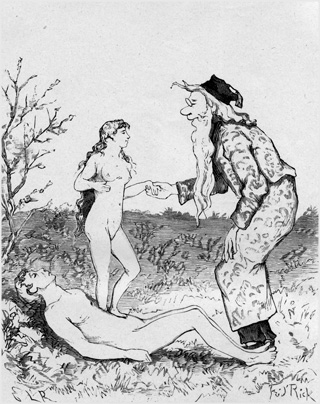
13. Creation of woman.
I hear the cry of the man, waking with a start:
— Ow! ow!... Oh! là là!... Somebody has just taken away one of my beefsteaks!
And his surprise on seeing the pretty living doll:
— What’s that there? (fr. ‘Qué qu’c’est qu’ça ?’: ‘Qu’est-ce que c’est que ça ?’ in a careless Paris pronunciation)
— That? that is your wife, and I present her to you, answers Jehovah... I dare you to say that I am not making you an agreeable present there!...
— The fact is that she is pretty...
— One could eat her up... Lucky fellow, you (fr. ‘Veinard, va !’: ‘veinard’ comes from ‘veine’, a vein of ore, and so a run of luck; ‘va !’, literally ‘go!’, only adds emphasis)!... And no mother-in-law!... You can boast of having all the luck, my boy.
The Bible relates that Adam exclaimed: « This time, this one is bone of my bones and flesh of my flesh. She shall be named maness (fr. ‘hommesse’, the word Ostervald’s Bible uses: a feminine made from ‘homme’, man, as ‘maness’ is made here from man; the Hebrew text does the same, ‘ishshah’ from ‘ish’, and the King James Bible keeps it with ‘Woman’ from ‘man’), for she was taken out of man. Therefore shall man leave his father and his mother, and shall join himself to his wife, and they shall thus be one and the same flesh. » (Genesis 2:23-24)
No need to comment upon this exclamation of Adam, the newly married man. Ah! in what gallant terms these things are put?... (fr. ‘qu’en termes galants ces choses-là sont mises’, a saying: how elegantly these things are put; the words of Philinte praising a bad sonnet in Molière’s ‘Le Misanthrope’)
As for the rib removed, it is well to recall that, in the opinion of St. Augustine, God never gave it back to Adam. Consequently, Adam lived thus, one rib short. « It was apparently one of his false ribs, Voltaire has remarked; for the lack of one of the principal ribs would have been too dangerous. »
Genesis tells us further (Genesis 2:25): « And Adam and his wife were both naked, and they had no shame thereof. » The pious commentators affirm that this nakedness [29] without any shame is a proof of the innocence of our first parents; had they always remained in the belief that there is no immodesty in walking about stark naked, it would have been the mark of a persevering perfection. In virtue of this biblical reasoning, one might therefore reckon as living in the state of perfection those savage tribes who wear no clothing, and there are still some: nevertheless, at the time of the discovery of America, the fanatical Spanish Catholics massacred en masse the native tribes who lived in fine innocence, and the priests blessed the massacrers. Furthermore, it has been noted that it was the cold which led to the invention of clothes; for the naked peoples are those who live in the hottest regions. Besides, when everybody is naked, nobody is ashamed of being so: one blushes only from vanity; one fears to show a deformity which others have not.
Let us come to the great affair, to the astonishing adventure which put an end, alas! to the happiness of Adam and his spouse.
« The Eternal God had made to spring out of the earth every tree desirable to the sight and bearing fruit good to eat; and he had put the tree of life in the midst of the garden of Eden, and the tree of the knowledge of good and evil. » (Genesis 2:9)
« The Eternal God had spoken to man with commandment, saying unto him: Thou shalt eat freely of every tree of the garden. Howbeit, as for the tree of the knowledge of good and evil, thou shalt not eat thereof; for, the same day that thou shalt have eaten thereof, thou shalt die the death most certainly. » (Genesis 2:16-17)
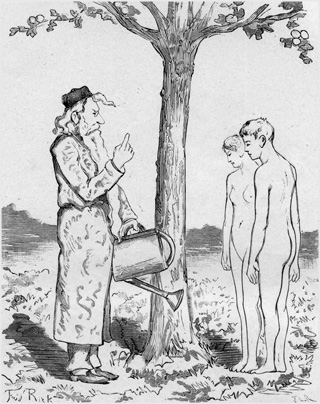
14. The forbidden fruit.
It is well to observe first of all that, under pretext of summarizing the Bible, the priests have drawn up for the use of the faithful certain little manuals bearing the title Sacred History, in which they take care to pass over in silence those passages of the divine Scripture which embarrass them too much. Thus, in general, the faithful are told only of the famous tree of the knowledge of good and evil; we shall see presently why the priests breathe not a word of the tree of life, perfectly distinct from the other tree; we shall reproduce verse 22 of chapter 3, which is always omitted in the books given to the simple devout.
For the moment, let us deal only with the [30] tree whose fruit caused the fall of man. Let us recall that the emperor Julian the Philosopher, whose memory is so execrated by churchmen, indulged in some remarks full of good sense about this marvellous tree. It seems to us, he wrote, that the lord God ought on the contrary to have ordered man, his creature, to eat much of this tree of the knowledge of good and evil; that not only had God given him a thinking head which had necessarily to be instructed, but that [31] it was still more indispensable to make him know good and evil, in order that he might fulfil his duties; that the prohibition was tyrannical and absurd; that it was a hundred times worse than if a stomach had been made for him in order to prevent him from eating.
Another reflection which one cannot help making is that the starting point of the little story proves that the lord Jehovah had an ulterior motive and that he was very glad [32] that man should sin. In short, Adam would have been entitled to say to him:
— My little Father Elohim, if I am not mistaken, good is that which is morally good, that which pleases you, and evil, on the other hand, is that which is bad, that which displeases you... Is that quite it?
— Perfectly, sonny, the Creator would have answered.
— Consequently, Adam would have continued, let me learn in what evil consists, in order that I may avoid it; or else why put this tree here, if I must not touch it?...
It is the curés (the parish priest, the clergyman ordinary people actually meet; English has taken the word from French, as it has ‘abbé’) who take the reply upon themselves, in the place and stead of their odd Good God.
— God, they say, was imposing a trial upon nascent humanity; he wished to see whether Adam would obey him, when he was asking of him only one single and very small privation.
But it is easy to reply to the reply. According to the curés themselves, God knows the future: he had therefore foreseen what was going to happen; and, as nothing is done without his will, he knew perfectly well that man would eat of the fruit of the tree in question. He therefore willed the fall of our first parents, of that there is no doubt whatever.
Moreover, all the rest of the story turns against the lord Jehovah.
Let us see how things came about, according to chapter 3 of Genesis:
« 1. And the serpent was the most crafty of all the animals of the earth which the Eternal God had made; and he said to the woman: What! Would God have said: Ye shall not eat of every tree of the garden?
2. And the woman answered the serpent: We eat of the fruit of the trees of the garden;
3. But, as for the fruit of the tree which is in the midst of the garden, God hath said: Ye shall not eat thereof and ye shall not touch it, lest ye die.
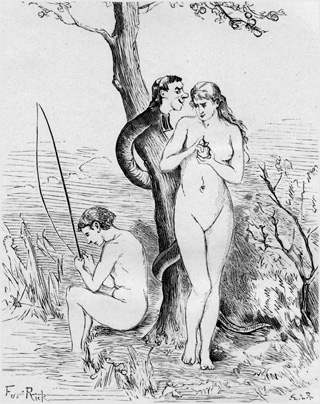
15. Eve tempted by the serpent.
4. Then the serpent said to the woman: Ye shall by no means die;
5. But God knoweth that in the day that ye eat thereof your eyes shall be opened, and ye shall be as the gods, knowing good and evil.
6. [33] The woman therefore saw that the fruit of that tree was good to eat and of an agreeable aspect, and that that tree was desirable to give knowledge; and she took of the fruit thereof and ate; and she gave also thereof to her husband, drawing him along with her; and he ate thereof. »
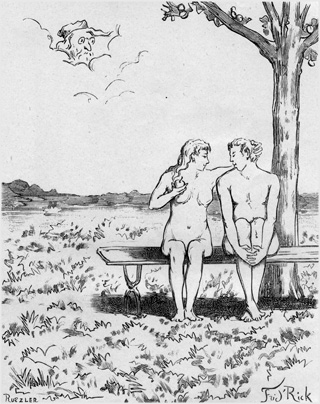
16. Disobedience of Adam and Eve.
What strikes one first of all, in this narrative, is that the discourse of the serpent, its conversation with the woman, the very fact of speaking, of expressing itself in the same language as our first parents, is not given by the sacred author as a supernatural, miraculous thing, nor as an allegory. It is indeed the serpent itself that Genesis presents; it is this reptile, playing the part of an animal full of mischief and cunning, which makes itself the tempter of the woman, with a fluency of elocution that a parrot might envy it.
The serpent has been so personally brought upon the scene that, ever since, the curés, finding the episode thus related improbable, have judged it necessary to make a correction in it which changes everything, but which is in contradiction with the whole text of this chapter of the Bible. According to the correctors, as artful as they are pious, it was the devil who took the form of the serpent and who, by means of this subterfuge, tempted Madame Adam; such is the way in which the priests have arranged the matter, such is their teaching today.
This arrangement is a veritable falsification of Genesis. In the first place, not one word of the sacred text lends itself to such an interpretation. In the second place, among the various authors of the books which compose the Bible, there are two in all who have mentioned the devil: the author of the book of Job, according to whom the devil argues one fine day with God, in heaven; and the author of the book of Tobit, who names a certain demon Asmodeus, in love with a woman named Sarah, whose seven husbands he strangles one after another. Now, these two books come quite at the end of the Bible, and there is no mention, in these any more than in the others, of the Lucifer-Satan whom the Catholics bring in on every occasion, to give spice to the interest of their legends. Nowhere does one find that adventure of Lucifer rebelling against God and vanquished by the archangel Michael, well known though it is. That, like everything which relates to the devil, was invented [34] after the event, not only long after Moses, but even after Ezra.
On the other hand, certain merry commentators, in reality sceptical philosophers, have amused themselves by turning the famous tree of the knowledge of good and evil into an apple tree of somewhat bawdy symbolism; and they have supposed that this episode signifies, in veiled terms, that Madame Adam, who knew nothing of love, received her first lesson in it from a [35] seducing devil, metamorphosed into a serpent for the occasion...
But while we laugh at this pleasantry, which is an interpretation as good as any other, we must put it into the same basket as the falsification of the text imagined by the curés. We must take the Bible as it is, when we wish to examine it seriously: thus, in the little story with which we are occupied at this moment, it is indeed the animal called the serpent that is in question, and not any devil [36] whatever, since the Jews had no devils in their mythology before the time when the books of Job and Tobit were written; and as for the amorous innuendoes, gratuitously attributed to the tempting serpent, it is evident that it is impossible to discover them in the text of Genesis, when one has it before one’s eyes.
It is truly the serpent alone, personally, that is in question; for the sacred author sees this animal with the eyes of all his contemporaries of the various religions. The serpent, in antiquity, was indeed held to be a very cunning animal, very intelligent and full of mischief. Several African peoples worshipped it. Furthermore, the case of this serpent that speaks, a case of which Genesis makes no miracle, is common to oriental literature; all the mythologies hatched in Asia are full of speaking animals; among the Chaldeans, the fish Oannes put its head out of the waters of the Euphrates every day, and, for whole hours together, it preached to the people who ran to the banks, giving good counsels, teaching poetry and agriculture at the same time. Those times when the animals had the power of speech are far distant; but no religion of the East had the monopoly of them. Therefore the biblical serpent spoke, without needing to be inhabited by an imp.
Besides, on this occasion, the serpent was less cunning than it appears. The tall tales of Holy Scripture are extraordinarily naive and are bursting with contradictions. Thus, it has been asked what the serpent meant by: « Ye shall be as the gods. » This expression, which affirms the plurality of gods, is not found in this passage of Genesis alone; we shall see further on that the lord Jehovah, speaking himself, does not consider himself the only God. The Catholic commentators, at a loss what to make of this phrase of the serpent, have maintained that by the gods the reptile must have meant the angels. It has been answered that a serpent could not know the angels; but, for the same reason, it could not know the gods. Naivety, contradiction, gibberish; there you have the Bible.
No, not so cunning as all that, this serpent!... Its counsels were very incomplete (the 1904 text has ‘forts incomplets’). A really crafty serpent would have said to the woman: — Eat of the forbidden fruit, first, and then [37] immediately afterwards, do not fail to eat of the fruit of the tree of life, which, moreover, is permitted thee.
And was not Jehovah the first cause of the temptation? Why had he given speech to the serpent? Without that gift, the latter could never have made itself understood by the woman.
The Bible does not report the conversation in which Madame Adam persuaded her husband to eat with her of the forbidden fruit. Fortunately, it is easy to fill up this gap left by the sacred author.
We see the first woman, whose curiosity has been pricked by the serpent, approach the tree of knowledge which is in the middle of the garden, beside the tree of life. She considers it at length, not without some hesitations.
— He is not handsome, handsome, says she, that serpent (in French the serpent is masculine: Eve speaks of a gallant, the seducing devil of the commentators, to whom plate 15 gives a man’s head) who spoke to me just now; but he is, faith, very distinguished in his manners, and he has a charming way of speaking... The counsel he gave me seems to me good to follow; for, really, it is very tiresome to know nothing... We are, Adam and I, like turkeys (fr. ‘comme des dindes’, an idiom: like simpletons; the turkey, brought from the New World, then called the Indies, was named ‘poule d’Inde’, and its stupid look made ‘dinde’ the word for a gullible woman), and we might be like gods!... And then, it is tempting, this fruit... There is none finer in the whole orchard... Still, if the serpent had told me a whopper (fr. ‘une craque’, a familiar word: a boastful lie, from ‘craquer’, to crack, which also meant to brag, to lie), that would not be pleasant!... Life is so agreeable!... I have a great desire to bite this fruit; but if the result of my greediness should be to die?... Not amusing at all, that...
She goes round the tree; the serpent, hidden behind a bush, follows all her movements from afar.
— No, it is not possible that we should die for so small a thing... It is Father Jehovah who has been setting up a boat for us!... (fr. ‘monter un bateau à quelqu’un’, an idiom: to deceive someone with an invented story) To begin with, thinking it over, I find he has a string look (fr. ‘l’air ficelle’, a slang idiom: a sly look; ‘ficelle’, string, is also slang for a sly man who knows every trick), that old greybeard... whereas the serpent... that is better (fr. ‘À la bonne heure !’, an exclamation: that is the way; approval, often ironic)... his little head, so dainty, has I know not what good-natured expression, with eyes sparkling with wit... Besides, it is strikingly logical, what he said to me... Father Jehovah has every interest in our remaining ignorant of the fine things which are the privilege of the gods... His threat, that must be to land a fit of nerves on us (fr. ‘ficher le trac’; ‘trac’ meant the sudden fear that seizes an actor before he goes on stage, and any sudden fright; the original phrase was ‘foutre le trac’, but ‘foutre’ also had the coarse meaning of the sexual act, and to avoid it Taxil wrote ‘ficher’), that is it... He does not wish us to know this and that... Oh! [38] the old men! they are all alike... sly rogues... tellers of nonsense... Mustn’t trust them...
She drags one of the garden benches up to the tree, climbs upon it, and gathers one of the fruits. — Let us say it is an apple, since the Bible is not explicit upon this point and since, moreover, it matters little whether we call this fruit that or something else. — She contemplates the apple, running her tongue over her lips. The serpent, who has seen [39] everything, rears upon its tail, behind the bush, and dances a merry quadrille. Madame Adam brings the apple near her mouth. — By the by, how does one eat this fruit?... Must I peel it or bite straight into it?... Enough (fr. ‘Baste !’, an old exclamation from the Italian ‘basta’: that will do! never mind!)! one way or another, it must be good... She hesitates a little more.
— To know everything or to know nothing, what an alternative!... When we play at hide-and-seek, Adam and I, is it good [40] or is it evil?... Cruel enigma!... Must we shear our sheep in order to do well? or does one commit evil by not leaving them the wool on their backs?... It is enough to make one lose one’s head... And Adam, who is for ever poking his fingers into his nose, is that good or is that evil?... Truly and truly, it is no life to be ignorant of such things!...
Making up her mind at once, she gives the apple an energetic bite.
— Sapristi! (an oath English has borrowed from French: ‘sacristi’ deformed, itself a deformation of ‘sacré’, sacred, so that one might swear without blaspheming) how good it is!...
Another bite, more energetic still.
— Name of there! (fr. ‘Nom d’ed’là !’, an oath: good heavens!; it is ‘Nom de Dieu !’, ‘Name of God!’, in popular speech, with ‘là’, there, put where ‘Dieu’, God, stood, so that God is not named) how good it is!... What a delicious taste!... Ah! the old swindler, who had forbidden me this goody!...
She lies down on the bench, stretches herself out on it and seems to savour the fruit all the better for it.
Adam, arriving, talking to himself: — To pass the time, I have just fished a fry out of the Tigris... but, as I am a vegetarian, I flung my fry, as soon as caught, into the Euphrates...
He catches sight of his spouse.
— Hey! maness, what are you nibbling there?
Madame Adam, sitting up with a bound:
Oh! do not scold me!... It is a fruit... from the tree... you know quite well... from one of the two trees in the middle of the garden...
— I see it, fichtre (a French oath: ‘foutre’, the coarse word for the sexual act, softened on the model of ‘ficher’, its milder stand-in)!... It is precisely the fruit of the tree which we are forbidden to touch... Well now! are you mad, my little wife?... And what about the warning of the other one?...
— Father Jehovah?... the hinderer of dancing in a ring?... (fr. ‘l’empêcheur de danser en rond’, an idiom: the spoilsport) Let us talk of him, ah! yes!... He has treated himself to our heads at the highest prices (fr. ‘dans les grands prix’, a slang idiom: thoroughly), the old monkey!...
— What’s that you’re singing me (fr. ‘Qu’est-ce que tu me chantes là ?’, a familiar idiom: what nonsense are you telling me?)?...
— His threat of death... you remember it, don’t you?..
— To be sure!... It sends a cold shiver down my back.
— Oh! la la! my eye! (fr. ‘mon œil !’, an exclamation: I don’t believe it!; said while pulling down the lower eyelid with a finger)... His threat, my dear, was a trick (fr. ‘truc’, a familiar word: a ruse, or the hidden device behind a stage effect)...
— Come now, are you beating Jeannot (fr. ‘battre Jeannot’, a turn no dictionary records: probably to rave, like ‘battre la campagne’; Jeannot, the pet form of Jean, John, is the ninny of the fairground farces), are you losing the ball (fr. ‘perdre la boule’, an idiom: losing your mind; the ‘boule’, the ball, is the head)?...
— A trick, I tell you... The proof is that I already know heaps of things, since I bit into the apple...
— You know what is good and what is evil?... You know what [41] must be done and what must not be done?... You know the how and the why of everything and everything?...
— Yes, it is beginning, my little green dog (fr. ‘mon petit chien-vert’, a slang pet name of the day, given to kept women; Eve coaxes Adam with it)... There, I already know how many grains of salt must be put in an egg.
— Not possible!
— I know why cocks shut their eyes when they crow...
— You astound me!... And do you know why frogs have no tails?
— I have just learned it this very instant...
— Tell me, for my instruction...
— It is because it would get in their way when they sit down.
— Ah! bah!... You knock me over...
— Better than that... Well, I know, I am sure, do you hear me, I am sure that you are a little man as good as a picture and that you have not been unfaithful to me a single time...
Adam is dumbfounded.
— A thousand firecrackers! she has suddenly got some knowledge, my wife has!... It is true, all the same, that I have never been unfaithful to her... Saprelotte of saprelotte! (an oath, doubled for emphasis: ‘sapre’ is ‘sacré’, sacred, and the ending turns aside ‘Dieu’, God, as ‘bleu’, blue, does in ‘sacrebleu’, so that the holy name is not spoken) it is prodigious!... And if I were to be unfaithful to you, would that be evil or would that be good?...
— That would be evil, sir!... very evil!...
She draws him beside her, on the bi of the end of the bench (fr. ‘sur le bi du bout du banc’, from the title of a café-concert song of 1886: on the very end of the bench, so sitting very close together; ‘bi’ means nothing and only echoes ‘bout’, end).
— Besides, Adam of my heart, it rests only with you to become learned like me, just as quickly and at as little cost... Bite into the apple...
She holds out the apple to him.
— It tempts me too, my dear little wife; but what good will it do us to be as learned as academicians, if we die of it this very day... For after all, one must reason it out: to die in a thousand years, if need be, would be all the same to me; but to break my pipe (fr. ‘casser sa pipe’, a familiar idiom: to die) this very day, no, that would be as stupid as anything...
Madame Adam shrugs her shoulders.
— You do not seem to believe it, my pretty... But I know quite well what old Papa Good God said to me; he spoke to me in person, and I assure you that he was categorical...
[42] Allow me to repeat his words to you verbatim: « As for the tree of the knowledge of good and evil, thou shalt not eat thereof; for, the same day that thou shalt have eaten thereof, thou shalt die the death most certainly »... There is no haggling (fr. ‘barguigner’, an old verb: to bargain, to hang back) about it, you see; I value my skin, I do, if you do not value yours...
— Adam, Adam, you make me laugh... Am I dead, tell me?
— [43] No, you are quite alive... Only, the day is not over; look out for the bomb!..
— Oh! how obstinate men are!... You can boast of having plenty of obstinacy, my dear!... It is absurd how long you take to understand that the old razor (fr. ‘le vieux rasoir’, a slang word: the old bore; ‘rasoir’, a razor, was slang for a very boring person) has been making fun of us... There, you have just mentioned the academicians...
— Yes; and what then?
— [44] The academicians... are they wells of learning, those gentlemen?
— Of course.
— Well, it is because they are wells of learning that the academicians are immortals... (the members of the Académie française are traditionally called ‘les Immortels’, the Immortals)
Adam is troubled by the argument. His spouse turns coaxing.
— Come, if only to please me, bite into the apple, my dear little man... When you have tasted of it after me, we shall both be like the gods...
— Like the gods?...
— Do not seek to understand... It is the serpent who said it...
Adam, resolved: — Since it is the serpent who said it!... Give, give me the apple...
He crunches the apple greedily.
Two minutes pass in silence; one might hear a Panamist fly. (fr. ‘on entendrait voler un panamiste’, a play on ‘on entendrait voler une mouche’, ‘one might hear a fly fly’, said of complete silence; ‘voler’ means both ‘to fly’ and ‘to steal’, and the Panamists, the men compromised in the Panama Canal scandal of 1892, stole) All at once, Adam utters a cry; it is knowledge coming to him.
— Belly of Saint Grey! (fr. ‘Ventre-saint-gris !’, an oath: King Henri IV’s favourite; in ‘ventre-Dieu’, ‘God’s belly’, ‘saint-gris’, Saint Grey, a saint who never was, stands where God stood, so that the oath is no blasphemy) he cries, we are naked as worms!... That is clean work! (fr. ‘c’est du propre !’, an exclamation: that is disgraceful!; said ironically)...
— Navel of the pope! says the woman in her turn, I have not even any garters!... It is indecent!...
— And to think we must go to the ball of the orang-outangs this evening!... Impossible to present ourselves in society, in so careless a costume!...
— Quick, quick, we must clothe ourselves!...
« And the eyes of them both were opened; and, knowing that they were naked, they sewed together fig-leaves and made themselves girdles thereof. » (Genesis 3:7)
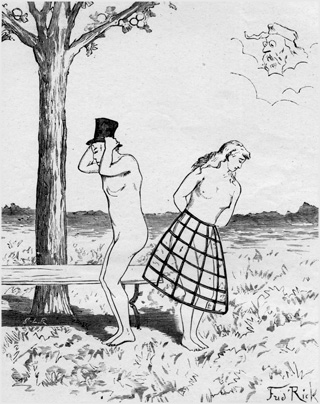
17. Adam and Eve are conscious of their nakedness.
Note well that the first human costume was not of vine leaves (in French the leaf that hides the sex of nude statues is a vine leaf, where English says a fig leaf: Taxil corrects the French commonplace by the verse he has just quoted); the glory of the invention of the vine was reserved for the patriarch Noah.
Once clothed thus, the two spouses look at each other.
— We are not too bad in this accoutrement, says the husband.
— As for me, the fig leaf suits me marvellously, says the woman... These garments are perhaps a little dusty; they have not been beaten since last season... Give me a brush down, Adam...
[45] Their contentment was not to last long.
« Then they heard, in the wind of the day which bloweth after noon, the voice of the Eternal God, who was strolling (sic) in the garden. And Adam and his wife hid themselves from the face of the Eternal God, among the trees of the garden. » (Genesis 3:8)
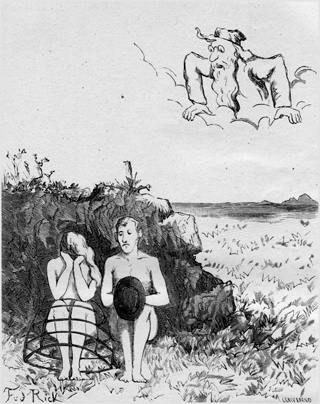
18. Adam and Eve hide at the call of God.
This Jehovah, as we observe here once again, is well and truly a corporeal god: he walks about, he speaks; we have seen him knead and blow. Genesis therefore presents its God after the fashion of all the other mythologies. The various peoples of antiquity had indeed no other idea of the divinity; Plato is held to be the first to have made God of a substance more or less ethereal, which was not altogether body.
The critics ask in what form God showed himself to Adam, and later to Cain, to the patriarchs, to the prophets, to all those to whom he spoke with his own mouth. The tonsured ones answer that he had a human form, and that he could not make himself known otherwise, since he had created man in his image. It is replied that, on this essential point, the Israelite religion then bears a singular resemblance to all the religions which the Catholic priests brand with the name of paganism; the ancient Romans, who had adopted the beliefs of the ancient Greeks, also conceived of the divinity only under a human aspect. This remark leads one to add: instead of its being God who made man in his likeness, might it not rather be man who imagined God in his own image? But let us not dwell on it; for to lodge such an opinion in one’s brain is to doom oneself to the flames of hell. Let us only recall this mischievous reflection of a philosopher: if cats had manufactured gods for themselves, they would have made them run after mice.
Details, such as those of God’s stroll in the garden of Eden, show peremptorily that this is in no way a mystical allegory; the whole narrative of the sacred author is in the style of a true history.
« 9. And the Eternal God called Adam, and said unto him: Adam, where art thou? »
He was piteous and confused, master Adam (fr. ‘messire’, an old title: used of a knight or a lord, and mock-solemn here), and his wife was not feeling very bold either. They try to slip away, they hide; but, I’ll give you some (fr. ‘je t’en fiche’, a familiar exclamation: not a chance!; said as a mock offer)! how are they to escape the divine gaze which [46] hovers over all?... In vain do the unfortunates strive to conceal their persons from the eyes of the Most High; behind them, everywhere, resounds the terrible call of the Lord, speaking as a powerful, severe master, and preparing to punish his servant, his slave, who has disobeyed him.
No way of getting out of this scrape; they are nabbed; they will have to confess their fault. Crestfallen, they will stammer out poor excuses.
« 10. [47] Adam answered: Lord, I heard thy voice in the garden, and I was afraid, because I was naked, and I hid myself. »
So there they are before the boss, before this God who knows the future, who had foreseen the accident of the serpent and the apple, and who grows angry as though he had suspected nothing, as though what has just happened had not come about by his omnipotent will. Adam and his wife do not think [48] of that in their agitation; they are going to use the language of schoolboys caught in a fault: — M’sieu (fr. ‘monsieur’ in the careless pronunciation), it wasn’t me who began; it was her! — M’sieu, I will not do it again, I am so sorry... Ah! no, for certain, I will not begin again, you may believe me!...
« 11. And God said unto Adam: Who hath taught thee that thou wast naked? Thou must have eaten of that which I had forbidden thee to eat.
12. And Adam answered: The woman whom thou gavest me to be with me gave me of the fruit of the tree, and I ate thereof.
13. And God said unto the woman: Wherefore hast thou done that? And the woman answered: The serpent deceived me, and I ate of the fruit. »
Now, master Elohim is going to distribute the punishments. He proceeds in order, and it is the one who was first guilty who will be the first to pay for it (fr. ‘écoper’, a slang word: to bail water out of a boat, the wettest job aboard, and so, probably, to be the one who takes the punishment). Attention!
« 14. Then the Eternal God said unto the serpent: Because thou hast done this, thou shalt be cursed among all the animals and beasts of the earth; thou shalt go upon thy belly henceforth, and thou shalt feed upon earth all the days of thy life.
15. And I will put enmities between thee and the woman, between thy children and the children of the woman; they shall seek to crush thy head, and thou shalt seek to bite them in the heel. »
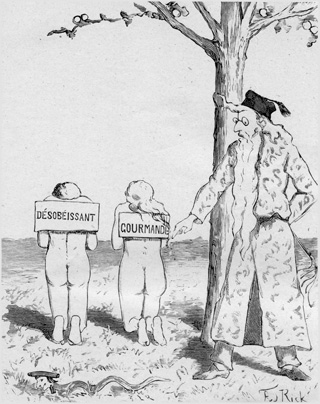
19. God reproaches Adam and Eve with their sin.
This chastisement inflicted upon the serpent proves, beyond any possible reply, that the curés are tellers of tall tales when, with their mania for thrusting the devil in everywhere, they attribute the temptation of the woman to the demon who on that day had borrowed the form of the reptile, to that Lucifer-Satan whose supposed revolt and defeat are recorded in none of the books of the Bible. If Satan were the guilty one, God would clearly have ordered him to return forthwith to his infernal domicile and would have granted him a supplement of torture in the abode of darkness.
Now, the punishment of the temptation strikes, solely and exclusively, the serpent as an animal and a beast of the earth. According to verse 14 of chapter 3, it would appear that this giver of perfidious counsels was previously an animal provided with feet; and it is indeed his feet that God cut off that [49] day, since he condemned him to crawl thenceforward — a chastisement which would be most unjust, if this beast had had nothing to do with the affair. — Suppose that the abbé Garnier (Théodore Garnier, priest, journalist and Catholic agitator of Paris, founder of the Union Nationale and an adversary of Taxil, whose hoax he denounced) should disguise himself one fine morning as an honest man, that he should take the costume and make himself up to look like Papa Ruel (Xavier Ruel, founder of the Bazar de l’Hôtel de Ville department store and a Paris city councillor famed for his charities; the French call an old man everyone knows ‘papa’), who is a philanthropist, and that he should then go under that name and commit swindles; what would happen when he was at last locked up, unmasked and brought before the correctional court (fr. ‘la correctionnelle’, short for ‘tribunal correctionnel’, the French court that tries misdemeanours)? would the tribunal condemn the worthy Papa Ruel to a fine and imprisonment? Certainly not! it would pronounce its sentence against the true swindler, it would apply its judgment to that Garnier, that is clear.
The tonsured ones would therefore do well to renounce their blue tale (fr. ‘conte bleu’, an old idiom: an idle tale; after the blue-covered cheap books of the ‘Bibliothèque bleue’) of Lucifer the tempter of the first woman; that tall tale will not stand up. Or otherwise, in view of the sacred text, if they wish to maintain it all the same, they must say that the devil was craftier than the lord Jehovah, and that the latter, completely softened in the brain (fr. ‘ramolli’, a familiar word: literally ‘softened’, said of a man whose wits have gone), saw nothing but the serpent in all this affair, did not perceive the least tip of Lucifer’s horn, and deprived the innocent serpent of its feet. My old Leo XIII, get out of that!
To tell the truth, from whatever point of view one considers this extravagant episode, it must be admitted that the hoaxer Holy Ghost has once more made fun of the pious author who wrote under his dictation. If it is true that the children of the woman, human beings, have a general aversion for serpents, if it is true that in case of an encounter the former try readily enough to crush the head of the latter, who for their part defend themselves or attack by seeking to bite the former in the foot or the leg, on the other hand there is one penalty pronounced by God against serpents which they have never undergone: serpents do not feed upon earth, never, never at all. This sentence has therefore been evaded, unless Jehovah declared the Bérenger law (fr. ‘la loi Bérenger’ of 1891, which introduced the suspended sentence into French law) applicable upon this point; in which case, the Bible has forgotten to mention this indefinite reprieve.
But, in order to savour the mystification of the Holy Ghost in all its merry mockery of the credulous devout, one must consider the immense extent of the chastisement inflicted upon the serpent. What exactly was the tempting ophidian? The
[50] Bible does not specify; but it matters little: it is evident that it could not be a viper and a grass snake at the same time, or a boa and a rattlesnake; the species of ophidians which live upon our globe are very numerous. Let us grant that it was the grass snake which provoked Madame Adam to sin; let us even grant, if you will, that the chastisement of the grass snake is reasonable in extending to the posterity of that species, and that all the grass snakes of the future are logically [51] deprived of feet to expiate the fault of the one in Eden... Now then, if the woman had not succeeded in drawing the man into her disobedience, she alone would have been punished, would she not?...
Well, poor serpents! the grass snake alone was guilty; but see how, at one and the same stroke, the asp, the naja, the rattlesnake, the cerastes, the slow-worm, the viper, the python, the cobra-capello, the rouleau, the elaps, the erpeton, the bothrops, the fer-de-lance, the atropos, the hypnale, the rhodostoma, the humbroni, [52] the bungarus, the psammophis, the rat-eating eunectes, the oxyrhopus, the boa constrictor, the molure, and their posterity, have lost their feet and crawl for ever, in spite of their incontestable innocence!...
« 16. God then said unto the woman: I will multiply thy miseries and thy pregnancies; and thou shalt bring forth in pain; and thou shalt be under the dominion of thy husband. »
The commentators are unanimously of opinion that the penalties of this sentence are aimed not only at Madame Adam, but at all women until the end of the world.
Without dwelling upon the injustice of this system, or how it denotes a tolerably mad (fr. ‘loufoc’, usually spelled ‘loufoque’, a slang word: ‘fou’ disguised in largonji, a Paris slang that sends a word’s first letter to the end, puts an l in front — ‘fou’ makes ‘louf’ — and adds any ending that sounds right, making ‘loufoc’; the slang is named ‘largonji’ for what it does to ‘jargon’) God, we shall note first of all that, if the first woman had been able to resist the seductions of the serpent, she would not have brought forth in pain. Before that day, she was therefore formed in a fashion altogether different from what she was at her first lying-in. Consequently, in one second, that is to say at the very instant when he pronounced his decree, God overturned the organism of woman from top to bottom. As we see, when the finger of God sets about it, it works astonishing things.
In the second place, it is well to observe that, in spite of this omnipotence, Jehovah has not succeeded in making general the penalties which he decreed against the feminine sex: on the one hand, there are many women who are delivered without pain; on the other hand, those who wear the breeches in their household, those who lead their husband by the tip of the nose, instead of being under his domination, those are legion in all classes of society.
« 17. Then God said unto Adam: Since thou hast hearkened unto the voice of thy wife, and hast eaten of the fruit of the tree which I had forbidden thee to eat, the earth shall be cursed because of thee, and thou shalt eat of it in labour all the days of thy life.
18. And the earth shall bring thee forth thorns and thistles; and thou shalt eat the herb of the fields.
19. And thou shalt eat thy bread in the sweat of thy brow, until thou return unto that earth whence thou wast taken; for thou art dust, and unto dust thou shalt return. »
The same observation as above: the chastisement of Adam must strike all men as well; perfect [53] unanimity of the theologians upon the interpretation of these three verses of Genesis.
The most terrible part of the sentence is the condemnation to death. It is true that the ineffable Jehovah forgets what he had decreed previously, that is to say that in case of the guzzling (fr. ‘boulottage’, a familiar word, from ‘boulotter’, to eat) of the forbidden fruit man should die the death on the very day of the offence (Genesis 2:17). This lapse of memory in Papa Good God earned the condemned a fairly considerable stay of execution; for, if the Bible is to be believed, Adam lived on for... nine hundred and thirty years (Genesis 5:5).
But if Adam had not eaten the apple, he would never have died, and we ourselves, all of us, should be immortal. Curious people ask: Then what would men have done on the day when the earth could no longer contain them? for, since Adam and his wife had received from their creation the faculty of multiplying, a moment would necessarily have come when their children and the children of their children would have peopled our planet in an exuberant fashion.
It is evident that this problem is insoluble. And so, in a sense, God needed Adam to commit the sin: death thus appears as a necessity; but God was anxious that man should imagine himself to be wholly in the wrong, and that is why he laid the snare of the apple for our first parents and gave speech to the serpent which he knew to be capable of temptation. If God exists as the Bible represents him, this is so exactly the case that the serpent has been dumb ever since that time, although the loss of speech does not figure among the penalties which were inflicted upon it.
Another observation comes to mind of its own accord, concerning the bread which Adam and his posterity were condemned to eat with a great deal of sweat. It is probable that there was no bread in primitive times and that men then fed themselves like the savage tribes which still exist in our day. But let us not cavil over so small a matter, and let us grant that the lord Jehovah spoke by anticipation. The Jews, for whom the Bible was written, did indeed eat bread. Now the tonsured ones tell us that this book was not written exclusively for the Jews and that it is, in the name of the Holy Ghost, the religious law of the whole world. In that case, one [54] is forced to admit that bread is eaten only in countries where wheat grows: the Lapps, herdsmen of reindeer and fishers of seals, and, in general, all the peoples of the polar latitudes, are absolutely ignorant of the existence of flour; in numerous regions of the Indies, of America, of central and southern Africa, people live on fruits and on the produce of the chase. Will it be said that the word bread was employed by God figuratively and that it designates every kind of food? One [55] may answer that the chastisement is not general either: if the workmen toil to feed themselves, if whoever lives by his labour finds himself thus stricken in consequence of the fault of Adam, the same is not true of the pleasure-seekers of life who are born rich, millionaires by inheritance. And what about the fat canons! when they sweat, it is in summer, on account of their fat; it is not their work which makes them water their daily bread with sweat!
[56] Verse 18, in particular, is very malevolent towards the human species. Apart from bread, man is condemned to eat only the herb of the fields, like cattle; what will the earth produce for him? thorns and thistles. The pigeon is telling us a fine tale! In spite of God, men eat something other than bread and grass. Ask Lucullus. Or else, why does Jehovah not destroy with thunderbolts the restaurants which take the liberty of displaying dishes of meat upon their bill of fare? No need to dwell on it.
Here one may well say that Adam would have been well inspired in sending Father Good God for a walk (fr. ‘envoyer promener quelqu’un’, an idiom: sending Father Good God packing; Taxil takes it literally, since Jehovah liked to walk in his garden), since walking pleases Jehovah.
But here is what happened after the pronouncing of the judgment:
« 20. Then Adam named his wife Eva, because she is the mother of all the living. »
The dear man had not yet thought of giving a name to his companion; until then he had confined himself to calling her maness , as we saw in verse 23 of chapter 2. What is curious is that the name given by Adam to his spouse should be precisely a Hebrew name; Hévah (Taxil’s spelling of the Hebrew name; the King James Bible has ‘Eve’, from the Hebrew ‘Chawwah’, ‘living’) signifies « life ». Hence one is entitled to put this dilemma to the author of Genesis: either the language of our first parents is Hebrew, and then, since that language has not been lost, the story of the tower of Babel must be struck out; or Adam gave his wife a name taken from the famous primitive language, today lost, and then the sacred author has committed a blunder. In either case, the inspiring pigeon has made fun of the writer once again.
Now, we are going to see that Jehovah did not immediately drive Adam and Eve from the earthly paradise, contrary to the widespread opinion. First, Papa Good God, finding their costume of fig leaves too scanty, turned tailor on the spot.
« 21. And the Eternal God made for Adam and for his wife robes of skins, and he clothed them therewith. »
So there we have a massacre of innocent beasts for the making of these garments; the slaughterhouse was inaugurated by Elohim in person. After that, how can you expect our [57] first parents not to have thought at once of using for their food the flesh of the animals so smartly immolated and skinned? Blast the diet of bread and grass! they must have said within themselves.
And the lord Jehovah might very well have left Adam and Eve to live and die in Eden, if, some time after having clothed them, he had not bethought himself of that wondrous tree of life, whose fruits the man and the woman had not had the idea of munching.
« 22. And the Eternal God said to himself: Behold, the man is become as one of us (sic); he knoweth good and evil. But, now, care must be taken lest he also put forth his hand towards the tree of life, and pluck the fruit thereof and eat, and thus live eternally. »
Such is verse 22 which the tonsured ones omit, and with good reason, from their summaries of the Bible.
Thus, this much is clear: our two ninnies Adam and Eve, to whom the fruit of the tree of life had not been forbidden, foolishly neglected it; and if the man and the woman, while Jehovah was busy cutting out their costumes of skins, had had the happy inspiration to pounce upon one of those marvellous fruits and to swallow it quickly, it is the old raging judge who would have made a nose! (fr. ‘faire un nez’, an idiom: to pull a vexed face)... Bang! all at once his sentence would have become unexecutable.
Is not the Holy Bible decidedly comical, as soon as you read it closely?... Not only does he have the dazzle (fr. ‘avoir la berlue’, an idiom: to see things that are not there; the ‘berlue’ is a passing dazzlement of the sight), this single God who lets slip an acknowledgment of the existence of several gods; but further, he, supposedly all-powerful, confesses, like an imbecile, that he is powerless to apply his decree of condemnation to death. What a little thing it hung on, just see! With a little presence of mind, Adam and Eve would have made themselves immortal, in spite of God himself!!!
And how the old Jehovah must have congratulated himself on having at last remembered that rascal of a tree of life!... no, to say so is to say nothing (fr. ‘ce n’est rien de le dire’, an idiom: saying so falls far short of the truth)... Of course, he had tied a knot in his handkerchief. But for that!...
« 23. And the Eternal God caused Adam to go forth from the garden of Eden, that he might till the earth whereof he had been kneaded.
24. Thus he drove out the man; and then he placed a Cherub [58] before the entrance of the garden, with a blade of a sword of fire, which turned this way and that to keep the way of the tree of life. »
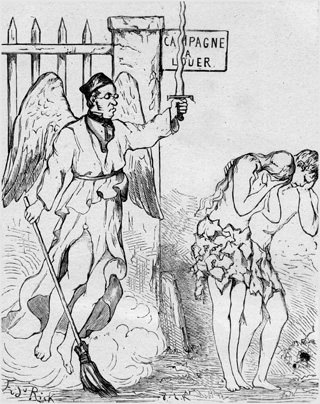
20. Adam and Eve driven from the earthly paradise. (the sign on the gate reads ‘Campagne à louer’, country house to let: Paradise is up for rent)
No mistake, is there?... It was indeed this unlucky tree of life which preoccupied master Elohim the most. On no account must Adam and Eve be able to return to it. But then what a confounded idea Papa Good God had had, to create that tree!... Come: with his knowledge of the future, he knew for certain [59] that our first parents would sin and that he would condemn them to death, them and the whole human race; so this tree of life could be nothing but a nuisance to him; it was so simple not to plant it!... Here is a blessed Jehovah who would do well to put himself on the regimen of showers (fr. ‘au régime des douches’: cold showers were the usual treatment in the asylums of the day); then again, perhaps hydrotherapy establishments shine, in heaven, by their absence (fr. ‘briller par son absence’, an idiom: what English calls being conspicuous by one’s absence), although the beginning of Genesis has taught us the existence of upper waters, situated above [60] the expanse in which the stars move... And again, this idea of immobilizing a Cherub with a flaming sword at the gate of Eden, that is what is so stupid, oh! yes!... With a word, with a single effort of will, God could have annihilated the troublesome tree of life, which henceforth had no reason to exist; and the Almighty never thought of it!...
Well, so be it for the Cherub, a sentry without a sentry-box!... This Cherub is a precious orderly, in case the discovery of Eden should tempt some new Christopher Columbus.
Come, a willing explorer is wanted. Among my readers, does anyone wish to put down his name?... Since Papa Good God took the trouble to have the gate of Eden guarded, since he went so far as to take defensive measures to prevent humanity for ever from entering the road which leads to the tree of life, it follows that the earthly paradise and the marvellous tree still exist somewhere. If, in exploring the region where the sources of the Tigris and the Euphrates are, we perceive upon a road, in front of a portal, a Cherub brandishing a blade of a sword of fire, we shall have no doubt, we shall be able to say: We are there! it is here!
A hundred thousand francs reward to whoever shall find the Cherub!
And first of all, what exactly is this parishioner (fr. ‘paroissien’, a familiar word: fellow)? « Cherub » is the word which figures in the Hebrew text of Genesis. This word signifies « an ox »; it comes from charab, « to plough ». For the Hebrews had kept numerous memories of their servitude in Egypt, and they copied the Egyptians pretty largely in many usages, even in what concerned the minute details of worship; thus they roughly carved oxen, which they made into kinds of sphinxes, composite animals, such as they placed in their sanctuaries. These figures had two faces, one of a man, one of an ox, and wings, as well as legs of a man and feet of an ox. Today, the tonsured ones have changed all that (an echo of Molière’s ‘Le Médecin malgré lui’, where the sham doctor Sganarelle, who has put the heart on the right and the liver on the left, answers ‘nous avons changé tout cela’, ‘we have changed all that’): they have turned the Cherub into the Chérubin, and the Chérubins of the new worship are young chubby-cheeked angels, but without bodies, having only a child’s head with two little wings; you see these comical angels in quantities of church pictures... It is probable that the angelic doorkeeper of the earthly paradise does not answer to this last description, and that it is, on the contrary, a Cherub in the [61] Hebrew fashion, with a head of two faces, one of them an ox’s; which will enable our explorer to recognize him from afar. Or, if it is a Chérubin in the Catholic fashion, without body or hands, it must be with his teeth that he holds his flaming sword, and, in that way too, he will not be able to remain unnoticed. But I incline towards the porter (fr. ‘pipelet’, after Pipelet, the porter in Eugène Sue’s novel ‘Les Mystères de Paris’; his name passed to every man of his trade) with the half-human, half-bovine head.
Courage then, to the search for Eden! notice to enthusiasts!... Even should we not succeed in penetrating it, the excursion will be interesting; we shall at the very least go round the garden, and we shall fix its site upon the maps, which would otherwise always be incomplete.
Meanwhile, let us now see what Adam and Eve did, once outside the earthly paradise, and having the entire knowledge of good and evil... including seasickness. (fr. ‘le mal’ is both evil and sickness, so that Taxil can slip ‘le mal de mer’ into the tree of the knowledge of good and evil)
CHAPTER 2
Short history of the first men
Holy Scripture does not abound in biographical details concerning the first men.
The fourth chapter of Genesis cuts short the suppositions of the jovial commentators, who wished to see the work of love in the story of the apple, gathered by Eve, on the counsel of the serpent, and eaten in common with Adam. It is after the expulsion from Eden that our first parents set about making themselves a posterity. The text of the Bible is sufficiently explicit.
« 1. And Adam knew Eve his wife, who then conceived and brought forth Cain; and she said: I have gotten a man by the Eternal.
2. She brought forth also Abel his brother. And Abel was a shepherd, and Cain was a tiller of the ground. »
Persons who have not gone deeply into the study of theology and of theologians are a thousand leagues from suspecting the extravagant discussions which this grave affair of the conception of the first human baby has stirred up among the [62] Jewish and Christian commentators. In spite of the above text, some, still not finding it clear enough, and partisans of the work of love accomplished in Eden all the same, have put forward the opinion that Eve, scarcely created, lost her virginity, and that the serpent, to tempt her, took advantage of the moment when Adam was asleep, resting from his conjugal fatigues. The others, headed by St. Jerome, who composed the Vulgate by translating directly from the Hebrew, are [63] of opinion that verse 1 of chapter 4 of Genesis proves that Adam never dreamed of knowing Eve until they were driven from paradise.
And the judgments have not stopped there!... The theologians who have adopted St. Jerome’s view have divided among themselves, in virtue of the fine reasoning which follows: granted that the consummation of the marriage took place after the departure from Eden, there is no reason why it should [64] have happened immediately, there and then, at once; then, when? at what precise moment?... When one is a theologian, one wants to rummage into everything; those men are unimaginably curious, above all in questions of this sort. There have therefore been people who have retailed that Adam put off the decisive operation for fifteen years and even thirty years. Others push the thing still further and gravely maintain that Adam and Eve, by a common resolution and in order to weep for their sin, broke their continence only at the end of... a hundred years!
You think that is the end?... Ah! how little you know the theologians! Some have unearthed a tradition, in virtue of which Adam is supposed to have remained excommunicated for a hundred and fifty years for having eaten of the forbidden fruit, and to have lived during that time with a woman who, like him, had been formed of the earth and whom they name Lilia; they add that he begot devils by his commerce with this woman, and that at last he married Eve, when his excommunication was lifted, and that then he begot men. It is only fair to say that this opinion has not prevailed. Finally, other commentators, likewise described as heretics and cited by St. Epiphanius, have maintained that the devil had had to do with Eve as a husband with his wife, and this even after the departure from Eden, and that he had had Cain and Abel by her. So there we have compensations: Adam leaves Eve to make devils with another woman, and the devil seeks out Eve to make men with her.
And the question of Eve’s confinements?... The dear theologians have found in it too an inexhaustible mine of controversies. But that would lead us too far. Lastly, let us recall a celebrated and learned dissertation of the German Reinhardt, in which the question is debated whether or not Adam and Eve had a navel!...
All that is nonsense, as the other fellow says. Let us come to what is serious, seeing that what is serious in the Bible is none the less enough to make one die of laughing.
So then Abel was a shepherd, and Cain a tiller of the ground (Genesis 4:2); and we are soon going to see that old crack-brain of a Jehovah prefer Abel to Cain. Now, I beg you to reflect upon it for one second only: which of the two sons of Adam, if you please, had [65] obeyed God in the choice of his profession? It was Cain, by blue! (fr. ‘parbleu !’, an oath: of course!; ‘par Dieu’, ‘by God’, with ‘bleu’, blue, put where ‘Dieu’, God, stood, so that God is not named; ‘morbleu’ and ‘sacrebleu’ are made the same way) since the Eternal had ordered humanity to cultivate the earth and to feed itself exclusively on what the fields should produce, save for turning the wheat into bread. Abel, for his part, sets up as a shepherd; if he kept and reared flocks of sheep, it was obviously not for the pleasure of watching them graze while threading pearls (fr. ‘enfiler des perles’, an idiom: wasting his time on trifles); it was, in reality, because he appreciated the sheep above all from the point of view of the leg and the cutlets, on which he regaled himself, that is self-evident. Abel therefore squarely contravened the express and recent divine prescriptions; and it is he who was the little darling of the lord Jehovah!... Decidedly, O priceless curés, it is not in your tabernacles that you must shut up your Papa Good God; it is in a cell at Charenton. (the asylum for the insane at Charenton, near Paris; in French its name had become a byword for a madhouse)
« 3. And it came to pass at the end of some time that Cain offered in oblation unto the Eternal of the fruits of the earth;
4. And that Abel also offered of the firstborn of his flock, and of their fat. And the Eternal was pleased with Abel and with his presents;
5. But he was not pleased with Cain nor with his presents. And Cain was angry, and his countenance was cast down. »
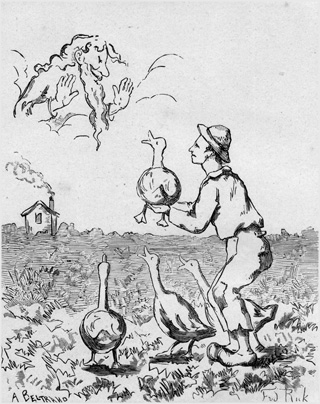
21. Offerings of Abel to God.
There was indeed reason to find it bad (fr. ‘la trouver mauvaise’, an idiom: to be far from amused).
« 6. And the Eternal said unto Cain: Why art thou angry and why is thy countenance cast down?
7. If thou doest well, shall it not be received? But, if thou doest not well, the penalty of sin is at the door. And its desires relate unto thee; and it shall be under thy power. »
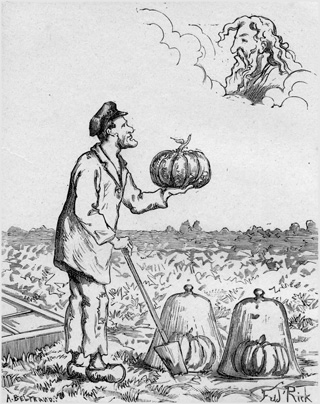
22. Offerings of Cain.
The Bible mentions no reply of Cain to God. I confess that, had I found myself in his place, the incomprehensible gibberish of verse 7 would have completely dumbfounded me.
Cain was not a prophet. Otherwise, ignoring the aforesaid gibberish, he might have answered his interlocutor:
— So it is the offerings of meat that you prefer, my old Jehovah?... Well then, you are setting an example which will be followed by the pagan sacrificers... You have precisely the same tastes as the idols will have, and these tastes will later be declared gross and unworthy of the divinity... do you know by whom?... by the very priests of Catholicism.
But Cain made no reply. This man, who had taken so much [66] trouble to bring the cultivation of his melons to a good end, who offered to the Lord his most succulent cantaloups and who saw them despised, this man understood that God was making fun of him into the bargain (fr. ‘par-dessus le marché’, an idiom: on top of everything else), and he was so vexed at it that he lost his head for a moment. Instead of bearing a grudge against the capricious and impolite Jehovah, he made the mistake of turning upon his brother.
« 8. And Cain said unto Abel his brother: Let us go forth. [67] And when they were in the fields, Cain rose up against Abel his brother, and slew him. »
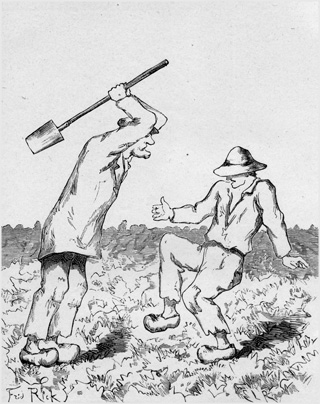
23. Murder of Abel by Cain.
It did not drag on, as you see; Cain was an expeditious fellow. He invites his brother to take a little stroll outside; he draws him off into the fields, under some pretext or other, to look for beetles together, for example. Once there, quickly a German quarrel, about boots (fr. ‘une querelle d’allemand, à propos de bottes’, two idioms: a ‘German quarrel’ is one picked for no reason, and ‘about boots’ means about nothing at all); then, a good blow with a pickaxe on the head. Bang! that is done. And it is the [68] darling of Papa Good God who, of all mankind, has the first use of death.
After which, what goes on in Cain’s noggin (fr. ‘la caboche’, a familiar word: the head)? Is he crushed at the sight of his crime?... Not at all. He is suddenly metamorphosed into a hardened scoundrel, into game for the convict-prison (fr. ‘gibier de bagne’, an idiom: a man who already belongs to the convict prison, as game belongs to the hunter). He has not the least remorse, and he, but a moment ago so dejected, is going to show himself insolent towards the lord Jehovah, who will inspire him with no fear whatever.
« 9. And the Eternal said unto Cain: Where is Abel thy brother? And Cain answered him: I know nothing of it; am I myself my brother’s keeper? »
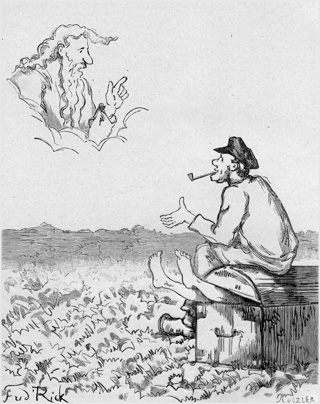
24. « Cain, what hast thou done with thy brother? »
One can almost see the picture: Papa Good God appearing at the corner of a cloud and calling out to the murderer, and Cain sending him something like And your sister? (fr. ‘Et ta sœur ?’, a saying: mind your own business!; a Paris retort) with the perfect serenity of a professional criminal, who believes he has made every trace of the assassination disappear and makes a foot-long nose at the gendarmes. But Jehovah had not missed a detail of the drama; his divine eye was not at fault, this time.
« 10. And God said: What hast thou done? The voice of thy brother’s blood crieth from the earth unto me. »
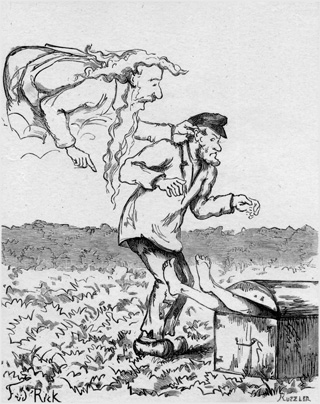
25. The blood of the victim rises up against the assassin.
It is clear that a terrible chastisement is going to punish so much villainy and effrontery.
Let us then see the rest of Jehovah’s discourse:
« 11. Therefore, now, thou shalt be cursed even by the earth, which hath opened her mouth to receive from thy hand thy brother’s blood!
12. When thou shalt till the earth, she shall no more yield thee her fruit; and thou shalt be also a vagabond and a fugitive upon all the earth. »
So Cain is condemned to vagabondage, to have neither fire nor place (fr. ‘ni feu ni lieu’, an idiom: neither hearth nor home), to walk always without being able to stop anywhere, a forerunner of the legendary Wandering Jew. But, if he is going to be a fugitive without rest or truce, he will not at the same time be a ploughman, which is an essentially sedentary profession; how would he set about ploughing, even to no purpose? — If a man charged with vagabondage proves to the tribunal that he is a ploughman, if he establishes that he possesses a field and that he cultivates it, his acquittal is certain; the accusation has collapsed, he is not a vagabond.
[69] Thereupon, Cain gets a fright (fr. ‘frousse’, a slang word: an extreme fear, often a senseless one), such a fright that he loses sight of the fact that humanity consists of three persons in all, his father, his mother and himself, and he imagines that he may be killed in his turn by the other men, who do not exist. That is a pretty cerebral derangement, that is! Well, it is there in the Bible, written out in full.
« 13. And Cain said unto the Eternal: My punishment is greater than I can bear.
14. Behold: thou hast driven me out this day from off this earth, and I shall hide myself from before thy face, and I shall be a vagabond and a fugitive upon all the earth; then it shall come to pass that whosoever meeteth me shall kill me. »
At this, the wrath of old Jehovah calms down. He does not remit Cain’s condemnation to perpetual vagabondage; but, losing all sense of the situation in his turn, he does not wish the penalty to be aggravated. And so he takes Cain under his protection against these impossible assassins. If that is not delirium, I ask what is!
« 15. And the Eternal said unto Cain: Whosoever shall kill Cain shall be punished sevenfold double. And God set a mark upon Cain, that those who should meet him might not kill him. »
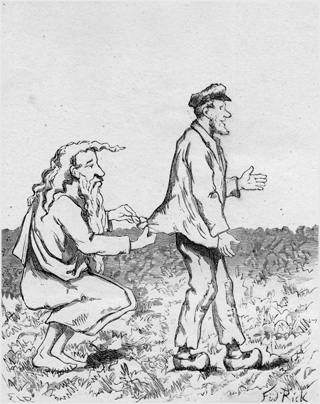
26. Cain is marked with a sign of reprobation.
One now expects to read some account of Cain’s vagabondage. Ah! well, no, indeed! Nobody was ever more sedentary than this fugitive.
« 16. Then, Cain went out from before the face of the Eternal, and he came to dwell in the land of Nod, on the east of Eden.
17. There, Cain knew his wife, who conceived and brought forth Enoch; and he built a city which he called Enoch, after the name of his son. »
We learn from this that Cain married: the author does not say whom; but it flows from the spring (fr. ‘il coule de source’, an idiom: it is self-evident) that Adam and Eve had daughters, of whom the Bible has neglected to speak, and that Cain married one of his sisters. We shall not hold it against him as a crime; incest was obligatory in the first ages of humanity.
What makes us jump instead, so great is our surprise, is this city founded by Cain. It is already a bit much, a vagabond who builds a city; but what workmen had he in his service? what instruments were used to construct the houses? and where, lastly, did Cain recruit citizens to [70] people his city of Enoch?... And the hoaxer Holy Ghost made the pious author whom he was inspiring swallow this fine story!...
The following verses give us the descendants of Cain. Enoch begets Irad; Irad begets Mehujael; Mehujael begets Methushael. Of these personages nothing is known but their names. Methushael begets a certain Lamech, greedier in marriage than his noble forefathers. The venerable Lamech is indeed the [71] inventor of polygamy; he treats himself to two wives all to himself, which proves that the article was ceasing to be rare. By his wife Adah he had two sons, named
Jabal and Jubal, and by his wife Zillah he had a son, Tubal-Cain, and a daughter, Naamah.
It appears that the sons of Jabal preferred the country to the city built by their ancestor Cain; for they were the first upon earth to dwell under tents (Genesis 4:20). As for the sons [72] of Jubal, the city pleased them, on the contrary, and they were the merriest of the family; they loved music. « Jubal was the father of all those who play the violin and the organ. » (4:21) Tubal-Cain, for his part, was the biblical Vulcan: « he forged all sorts of instruments of brass and iron. » (Genesis 4:22)
The polygamist Lamech seems to have lodged in his ceiling a spider of a fairly good size (fr. ‘avoir une araignée au plafond’, an idiom, literally ‘to have a spider on the ceiling’: to be slightly mad, the ceiling being the head); for Genesis reports a speech of his which has the merit of being short, but which no commentator has ever been able to understand.
« 23. And Lamech said one day unto Adah and unto Zillah, his wives: Wives of Lamech, hearken well unto my words. I will kill a man, if I be wounded; I will kill even a young man, if I be bruised.
24. For, if Cain was to be avenged sevenfold double, I, Lamech, shall be avenged seventy times seven times. »
This discourse astounded Mesdames Adah and Zillah in the highest degree; they were, no doubt, as though petrified by it and did not ask for the least explanation. Holy Scripture passes straight on to mention the birth of Seth, the third son of Adam.
« 25. And Adam again knew his wife, who brought forth a son and called him Seth; for God, said she, hath given me another son, in place of Abel whom Cain slew.
« 26. And a son was born to Seth, and he called him Enos. It was then that men began to invoke the name of Jehovah. »
The fifth chapter of Genesis is devoted solely to giving the genealogy of Noah, a descendant of Adam through Seth. The sacred author concerns himself no further with the descendants of Cain.
So we find the following order, in which only the eldest sons are named: Seth, Enos, Cainan, Mahalaleel, Jared, Enoch, Methuselah, Lamech, Noah. But the most curious thing in this chapter is the affirmation of the extraordinary longevity of all these patriarchs. Adam was a hundred and thirty years old when he had Seth, and he lived eight hundred years more. Seth died at nine hundred and twelve; Enos, at nine hundred and five; Cainan, at nine hundred and ten, etc. The one who died youngest was Lamech, father of Noah; this Lamech, who must not be confounded with the crack-brained polygamist of a moment ago, deceased in the seven hundred and seventy-seventh spring of his age.
[73] Enoch, son of Jared, was craftier than all the others; he quite simply did not die.
« 21. Enoch lived sixty-five years, and he then begat Methuselah.
22. And Enoch, after he had begotten Methuselah, strolled with God (fr. ‘se promena avec Dieu’: Ostervald’s Bible has ‘marcha avec Dieu’, ‘walked with God’; the stroll comes from Voltaire’s verse 24, ‘Il se promena avec Dieu’, and Taxil carries it into this verse too) for three hundred years; and he begat sons and daughters.
23. All the time therefore that Enoch lived was three hundred and sixty-five years.
24. And Enoch, having thus strolled with God, appeared no more, because God took him away. » (Genesis, ch. 5)
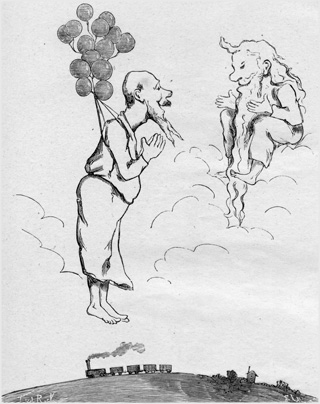
27. Enoch, an old patriarch, is caught up to heaven.
This episode is too fine; any commentary whatever would deflower it. Let us admire!
As for Methuselah, it is he who unhooked the cup of longevity (fr. ‘décrocher la timbale’, an idiom: carried off the prize; at fairs a cup, the ‘timbale’, hung at the top of a greased pole, and whoever climbed to it won it). He had sinew, the old fellow; judge for yourselves. He lived in continence until the age of a hundred and eighty-seven years, a happy time at which he treated himself to the luxury of having a brat (fr. ‘un moutard’, a familiar word: a small child), and, after the birth of young Lamech II, he found a way to live seven hundred and eighty-two years more, giving proofs of his virility to the very end.
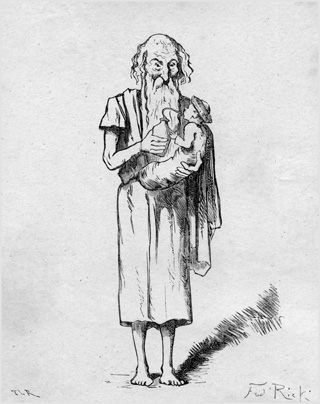
28. Methuselah is a father at a hundred and eighty-seven years.
« 26. Methuselah, after he had begotten Lamech, lived seven hundred and eighty-two years, still begetting sons and daughters. » (Verbatim!)
Total: nine hundred and sixty-nine years. Excuse the little!... (fr. ‘Excusez du peu !’, an exclamation: said in irony at something excessive, as though apologizing for how little it is) People were hard to kill (fr. ‘avoir la vie dure’, an idiom: to resist death, or the wear of time), in those days.
And Father Noah?...
« 30. Lamech called his son Noah, saying: This one shall relieve us of our work and of the labour of our hands, upon this earth which the Eternal hath cursed...
33. And Noah had passed five hundred years, when he begat Shem, Ham and Japheth. »
To be five hundred years old, and only then to begin pecking one’s little wife (fr. ‘becqueter’, a familiar word: covering with little kisses)?... Better late than never!...
Much ink has flowed over the extraordinary longevity of the patriarchs of Genesis. Catholic doctors, feeling that these tall tales were far too hard to digest, have attempted to save the narratives of the Holy Ghost from ridicule; they have advanced that one ought perhaps to understand years as lunations, insinuating that at that time [74] people no doubt reckoned solely by moons. At that rate, Methuselah would have died an octogenarian, that is all. But these obliging commentators have been roundly snubbed by the fanatics who set store by these miracles of longevity of the first men.
Canon Rohrbacher, among others, in his Universal History of the Church, declares that these are indeed years of twelve months, and he cites, notably, the example of Abraham, [75] who, according to Genesis, « died in a happy old age, being very aged and full of days, having lived a hundred and seventy-five years » (Genesis 25:7-8). If one had to reckon by lunations,
Abraham would then have lived only fourteen years and seven months in all, says Rohrbacher, and that would not accord with the expressions employed by the sacred author. The same theologian, in order to prove that the years indicated in Genesis are really of twelve months, also cites [76] several personages whose age at the birth of their first-born is given by the divine text: Enos, Cainan, Mahalaleel begot at the ages of ninety, seventy and sixty-five; reckoning by lunations, says Rohrbacher, it would then have to be admitted that they had children at the ages of seven and a half, five years ten months, and five years five months! And as for Nahor, who begot at twenty-nine according to the biblical text, can one reasonably believe, cries the learned canon, that this means that he was in reality two years and five months old when he had his first child?...
No, good Rohrbacher, and it is you who are in the right: the years Genesis speaks of are incontestably years of twelve months. And so, nothing is more amusing than the case of good old Noah, who waited until he was a full five hundred years old before he got down to zizi-panpan (a nursery-sounding French phrase for making love, built of two children’s words: ‘zizi’, a boy’s pee-pee, and ‘panpan’, smack-smack, the sound of a spanking).
